EMI Calculator Calculate Your Monthly Loan EM
EMI Calculator: Calculate Your Monthly Loan EMI, Intere...
October 3, 2026


How EMI Is Calculated in India: A Complete Guide
Taking a loan is a major financial decision. Whether you are borrowing money to buy a home, purchase a car, fund an education, manage a medical expense, or meet a personal requirement, one number quickly becomes important: your Equated Monthly Instalment (EMI).
EMI is the fixed amount you generally pay to a lender every month until your loan is fully repaid. But an EMI is more than just a monthly payment. It combines two important components—principal and interest—and the amount you pay depends on factors such as the Principal Loan Amount, Interest Rate, and Loan Tenure.
Understanding how EMI is calculated in India can help you compare loans, estimate affordability, understand the real cost of borrowing, and make better repayment decisions. It can also prevent a common mistake: choosing a loan simply because its monthly EMI looks affordable.
For example, a longer loan tenure may reduce your monthly EMI, but you could end up paying substantially more interest over the life of the loan. Similarly, a slightly lower interest rate can make a meaningful difference when the loan amount and tenure are large.
The good news is that EMI calculation is based on a standard mathematical formula. Once you understand the formula and the factors involved, you can estimate your monthly payment and understand how your loan repayment works.
What Is EMI?
Equated Monthly Instalment (EMI) is the amount a borrower pays to a lender at regular monthly intervals to repay a loan.
For most standard reducing-balance loans, every EMI contains two parts:
Although the EMI may remain the same throughout the repayment period for a typical fixed-rate loan, the proportion allocated toward principal and interest changes over time.
At the beginning of the loan, a larger portion of the EMI generally goes toward interest because the Outstanding Loan Balance is still high. As the outstanding principal decreases, the interest charged each month also decreases, allowing more of the EMI to go toward principal.
This is why simply multiplying your EMI by the number of months does not tell you how much you are paying toward the original loan.
Your Total Repayment Amount is generally calculated as:
Total Repayment Amount = EMI × Number of Monthly Instalments
The difference between the total repayment amount and the original principal represents the interest component, subject to how the lender structures the loan and excluding additional charges.
The Main Factors Used to Calculate EMI
The amount of your monthly EMI is primarily determined by three variables:
Understanding these three factors is essential before taking any loan.
The Principal Loan Amount is the amount you borrow from the lender.
For example, suppose you take a personal loan of ₹5 lakh. Your initial principal is ₹5,00,000.
Generally, a higher loan amount results in a higher EMI if the interest rate and tenure remain unchanged.
Consider two borrowers taking loans at the same interest rate and for the same tenure:
Borrower B will generally have a significantly higher EMI because the amount being repaid is twice as large.
This is why determining how much you actually need to borrow is an important part of responsible financial planning.
Borrowing more than necessary can increase both your monthly obligation and the Total Interest Payable.
The Interest Rate is the cost of borrowing.
In India, lenders generally quote loan interest as an annual percentage rate. This is commonly referred to as the Annual Interest Rate.
For example, a lender might offer a loan at 10% per year.
However, the EMI formula requires the annual rate to be converted into a Monthly Interest Rate.
For a basic monthly conversion:
Monthly Interest Rate = Annual Interest Rate ÷ 12 ÷ 100
So, if the annual interest rate is 10%:
10 ÷ 12 ÷ 100 = 0.008333
The monthly rate is therefore approximately 0.8333%.
A higher interest rate generally means a higher EMI and a higher total interest cost, assuming the loan amount and tenure remain unchanged.
The Loan Tenure is the period over which you repay the loan.
It may be expressed in months or years.
For example:
A longer tenure generally reduces the monthly EMI because the repayment is spread over more months.
However, there is an important trade-off.
A longer tenure can substantially increase the amount of interest you pay over the entire loan period.
For example, imagine you are considering two otherwise identical loans. A five-year loan may have a higher EMI but a lower overall interest cost, while a ten-year loan may have a lower EMI but a much higher total interest cost.
Therefore, the lowest EMI is not necessarily the cheapest loan.
How the EMI Calculation Formula Works
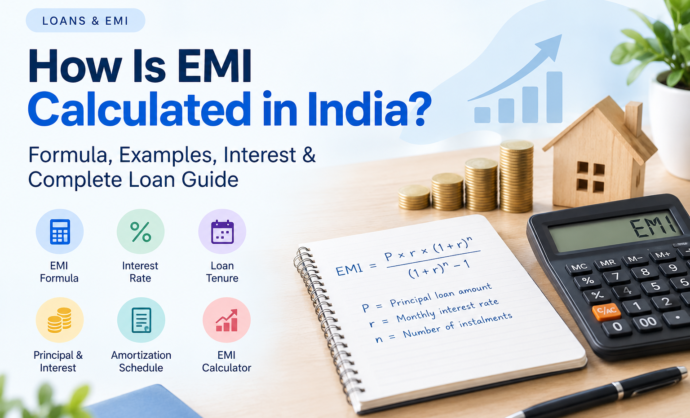
The standard EMI Calculation Formula for a reducing-balance loan is:
For EMI calculation, this relationship can be rearranged to determine the monthly payment:
EMI = P × r × (1 + r)ⁿ ÷ [(1 + r)ⁿ − 1]
Where:
Let’s understand each part.
This is the amount borrowed.
If you borrow ₹5,00,000:
P = ₹5,00,000
The annual interest rate needs to be converted into a monthly decimal rate.
Suppose the annual interest rate is 12%.
Monthly rate:
12 ÷ 12 ÷ 100 = 0.01
Therefore:
r = 0.01
The tenure must be converted into months.
For example, a five-year loan has:
5 × 12 = 60 months
Therefore:
n = 60
Once these values are entered into the formula, the resulting figure is the monthly EMI.
Example: How EMI Is Calculated
Let’s take a simple example.
Suppose you borrow:
The first step is converting the annual rate into a monthly rate.
12% ÷ 12 = 1% per month.
As a decimal:
r = 0.01
The tenure is:
5 × 12 = 60 months
So:
Using the standard EMI formula, the monthly EMI is approximately ₹11,122.
Over 60 months, the approximate total repayment would be:
₹11,122 × 60 = ₹6,67,320
The approximate interest component would therefore be:
₹6,67,320 − ₹5,00,000 = ₹1,67,320
The actual amount charged by a lender can differ slightly because of rounding, payment dates, lender-specific calculations, fees, insurance, and other applicable charges.
This example demonstrates an important point: a ₹5 lakh loan does not mean you simply repay ₹5 lakh. The cost of borrowing is reflected in the interest component of your EMIs.
Why the EMI Usually Stays the Same but the Components Change
One of the most confusing aspects of loan repayment is that the EMI can remain constant while the amount going toward principal and interest changes every month.
This happens because most standard EMI loans use a Reducing Balance Method.
Under this method, interest is calculated based on the outstanding principal rather than the original loan amount throughout the entire tenure.
Imagine that your outstanding principal at the beginning of a month is ₹5,00,000.
If your monthly interest rate is 1%, the interest for that month would be approximately:
₹5,00,000 × 1% = ₹5,000
If your EMI is ₹11,122, the remaining amount—approximately ₹6,122—goes toward reducing the principal.
The new outstanding balance would therefore be approximately:
₹5,00,000 − ₹6,122 = ₹4,93,878
In the next month, interest is calculated on this lower outstanding balance.
That means the interest component gradually falls.
At the same time, the principal component gradually increases.
This is why the Principal and Interest Components of an EMI change over the repayment period even when the total EMI remains approximately the same.
Understanding an Amortization Schedule
An Amortization Schedule is a month-by-month breakdown of your loan repayment.
It generally shows:
For example, a simplified schedule might look like this:
| Month | EMI | Interest | Principal | Outstanding Balance |
|---|---|---|---|---|
| 1 | ₹11,122 | ₹5,000 | ₹6,122 | ₹4,93,878 |
| 2 | ₹11,122 | ~₹4,939 | ~₹6,183 | ~₹4,87,695 |
| 3 | ₹11,122 | ~₹4,877 | ~₹6,245 | ~₹4,81,450 |
The figures are illustrative and rounded.
As the balance falls, the interest charged each month also falls.
This allows an increasing share of the EMI to reduce the principal.
By the final stages of the loan, the interest component is much smaller compared with the beginning of the repayment schedule.
An amortization schedule is particularly useful because it lets you see what is actually happening to your loan instead of looking only at the EMI.
EMI for Personal Loans vs Home Loans
The basic principle behind EMI calculation is similar across many loans, but loan products can differ significantly in terms of interest rates, tenure, fees, and repayment conditions.
Personal Loan EMI
A Personal Loan EMI is the monthly payment made toward an unsecured personal loan.
Personal loans generally have shorter repayment periods than home loans, although the exact tenure depends on the lender and product.
Because personal loans are typically unsecured, interest rates can be higher than those offered for some secured loans.
Suppose someone borrows ₹5 lakh for five years.
The EMI will depend on the interest rate offered by the lender.
Even a small difference in the rate can affect:
Therefore, borrowers should compare the complete cost of the loan rather than focusing only on the advertised EMI.
Home Loan EMI
A Home Loan EMI is the monthly payment toward a housing loan.
Home loans can have much longer tenures than personal loans. A longer repayment period can make a large loan more manageable on a monthly basis.
However, because the loan remains outstanding for many years, the total interest payable can become substantial.
For example, reducing the tenure may increase the monthly EMI but potentially reduce the total interest paid over the life of the loan.
This is why home buyers should evaluate both affordability and long-term cost.
What Is an EMI Calculator and How Does It Help?
An EMI Calculator is a financial tool that estimates your monthly loan repayment based on the loan amount, interest rate, and tenure.
Instead of manually applying the mathematical formula, you can enter:
The calculator then provides an estimated EMI.
Many calculators also show:
This makes an EMI calculator useful when comparing different loan scenarios.
For example, you could calculate the EMI for:
₹10 lakh at 10% for 5 years
and compare it with:
₹10 lakh at 10% for 7 years
The second option may have a lower monthly EMI, but the total interest paid can be higher because the loan remains outstanding for longer.
An EMI calculator therefore should not be viewed simply as a tool for finding the smallest monthly payment. It is better used as a decision-making tool.
How Loan Tenure Affects Your EMI and Total Interest
Loan tenure has a direct impact on the relationship between your monthly payment and overall borrowing cost.
Consider a borrower who wants to take a ₹10 lakh loan.
They might have several tenure options:
A shorter tenure generally means:
A longer tenure generally means:
This creates an important financial trade-off.
If your income comfortably supports a higher EMI, a shorter tenure may reduce your overall interest cost.
However, choosing an excessively short tenure can put pressure on your monthly cash flow.
The right choice depends on your income, expenses, emergency savings, other debts, and financial goals.
The objective should not simply be to minimize EMI.
Instead, try to find a repayment amount that is comfortable every month while keeping the total borrowing cost under control.
What Is Total Interest Payable?
Total Interest Payable is the amount of interest you are expected to pay over the loan’s repayment period, assuming the agreed rate and repayment schedule remain unchanged.
A simple way to estimate it is:
Total Interest = Total Repayment Amount − Principal Loan Amount
For example, if:
Then:
Total interest ≈ ₹1,67,320
This figure is important because two loans with identical principal amounts can have very different total costs.
The difference may arise from:
Therefore, when comparing loans, always look beyond the EMI.
What About Processing Fees and Other Charges?
The EMI calculation generally focuses on the principal, interest rate, and tenure. However, your actual cost of borrowing may include other charges.
One common example is a Processing Fee.
A lender may charge a processing fee for evaluating and processing the loan application.
Other possible costs can include:
These charges may not always be included in the EMI.
For this reason, borrowers should look at the loan’s overall cost rather than assuming that the EMI represents every expense associated with borrowing.
Before accepting a loan, read the lender’s terms carefully and understand which charges are included and which are separate.
How Prepayment and Foreclosure Can Change Your Loan Cost
Prepayment and Foreclosure can significantly affect the total interest you pay.
Prepayment
Prepayment means paying an additional amount toward your loan before the scheduled repayment date.
For example, suppose your outstanding loan balance is ₹4 lakh and you receive a bonus of ₹1 lakh.
If the loan terms allow you to make a partial prepayment, you could use some or all of that money to reduce the outstanding principal.
A lower principal balance means future interest may be calculated on a smaller amount.
Depending on the loan structure, this could reduce your total interest cost or shorten the repayment period.
Foreclosure
Foreclosure generally refers to closing the loan before the original tenure ends by paying the remaining outstanding amount.
Whether foreclosure charges apply depends on the type of loan, lender, borrower category, applicable regulations, and loan terms.
Therefore, never assume that early repayment is automatically free.
Check the applicable terms before making a large prepayment or closing a loan.
How to Read Your Loan Repayment Schedule
Your Loan Repayment Schedule provides a roadmap of how your loan is expected to be repaid.
When reviewing it, pay attention to:
1. EMI Amount
This shows the scheduled monthly payment.
2. Principal Component
This tells you how much of each EMI reduces the loan balance.
3. Interest Component
This shows how much you are paying for borrowing the money.
4. Outstanding Loan Balance
This indicates how much principal remains after each payment.
5. Total Interest
This helps you understand the cumulative cost of borrowing.
Reading the repayment schedule can also help you make better decisions about prepayments.
For instance, if you notice that your outstanding principal remains high during the early years, you may understand why early prepayments can potentially have a greater impact on future interest than the same payment made much later.
Does Compounding Frequency Affect EMI?
Compounding Frequency describes how frequently interest is calculated or applied under a particular financial product.
For standard monthly EMI loans, the lender’s loan agreement specifies how interest is calculated and how the EMI is determined. Borrowers should therefore avoid assuming that every financial product uses exactly the same interest calculation method.
For a conventional reducing-balance EMI calculation, the annual rate is commonly converted into a monthly rate for the mathematical formula.
However, the way interest is quoted and calculated can differ across financial products.
This is particularly important when comparing loans advertised using different rate structures.
Always check:
The headline interest rate alone may not provide the complete picture.
Fixed-Rate and Floating-Rate Loans
Another important consideration is whether the interest rate is fixed or floating.
Fixed-Rate Loan
With a fixed-rate loan, the interest rate remains unchanged for the agreed fixed period, subject to the loan’s terms.
This provides greater predictability because the borrower has more certainty about the scheduled EMI.
Floating-Rate Loan
With a floating-rate loan, the interest rate can change based on the terms of the loan and the benchmark or reference mechanism used by the lender.
When the interest rate changes, the lender may adjust the EMI, tenure, or both, depending on the loan agreement.
This means your original EMI calculation may not remain unchanged throughout a long-term loan.
Borrowers should therefore understand the rate-reset mechanism before accepting a floating-rate loan.
Common Mistakes People Make When Calculating EMI
Understanding the formula is useful, but many borrowers still make mistakes when evaluating loans.
Mistake 1: Looking Only at EMI
A lower EMI can look attractive.
But if the lower EMI results from a much longer tenure, you may pay substantially more interest.
Always compare the EMI and the total repayment amount.
Mistake 2: Ignoring Interest Rate Differences
Even a small difference in the annual interest rate can matter significantly for a large or long-term loan.
Use an EMI calculator to compare scenarios instead of relying on rough estimates.
Mistake 3: Forgetting Fees
Processing fees and other charges increase the overall cost of borrowing.
Ask the lender for a complete breakdown of charges before accepting the loan.
Mistake 4: Borrowing More Than Necessary
A higher principal means higher repayment obligations.
Before taking a loan, determine how much money you actually need.
Mistake 5: Choosing a Tenure That Is Too Long
Long tenure can make the EMI easier to manage but can increase total interest.
Mistake 6: Ignoring the Loan Agreement
The EMI formula does not tell you everything about a loan.
You should also review:
How to Choose an Affordable EMI
A mathematically calculated EMI may be affordable on paper but uncomfortable in real life.
Before taking a loan, look at your complete monthly budget.
Consider:
Suppose your calculated EMI is ₹25,000.
If your monthly budget is already tight, adding another ₹25,000 commitment may create financial stress even if the lender approves the loan.
A better approach is to calculate your disposable income first and then determine what EMI you can comfortably sustain.
Remember that loan approval and financial affordability are not the same thing.
A lender may approve a particular loan amount based on its eligibility criteria, but that does not automatically mean borrowing the maximum amount is the right decision for you.
How to Reduce Your Total Interest Cost
There are several legitimate ways borrowers may reduce the overall cost of a loan.
Choose a Suitable Tenure
A shorter tenure can reduce the total interest paid, provided the EMI remains affordable.
Compare Interest Rates
Compare offers from multiple lenders instead of accepting the first available loan.
Make Appropriate Prepayments
If your loan terms permit it and you have surplus funds, partial prepayments can reduce the outstanding principal.
Avoid Unnecessary Borrowing
The simplest way to reduce interest is to borrow only what you genuinely need.
Improve Your Credit Profile
A stronger credit profile may help you access better loan terms, depending on the lender’s eligibility criteria and underwriting policies.
Review Existing Loans
If you have multiple loans, periodically review their interest rates and repayment costs.
However, refinancing or transferring a loan should only be considered after comparing all associated charges and the actual savings.
EMI Calculation: A Practical Checklist
Before taking a loan in India, use this checklist:
1. Determine the loan amount
How much do you actually need?
2. Check the annual interest rate
Do not compare loans solely by EMI.
3. Convert the tenure into months
For example, five years equals 60 months.
4. Calculate the EMI
Use the lender’s official calculator or a reliable EMI calculator.
5. Check total interest
Look at how much interest you will pay throughout the tenure.
6. Check total repayment
Compare the principal with the total amount you will repay.
7. Review the amortization schedule
Understand how the principal and interest components change.
8. Check processing fees
Find out whether there are upfront charges.
9. Review prepayment rules
Understand the conditions for partial prepayment and foreclosure.
10. Check whether the rate is fixed or floating
This is particularly important for long-term loans.
11. Evaluate affordability
Make sure the EMI fits comfortably into your monthly budget.
12. Read the loan agreement
Understand the complete terms before signing.
What is EMI?
EMI stands for Equated Monthly Instalment. It is the scheduled amount a borrower pays each month toward repaying a loan, generally consisting of principal and interest.
How is EMI calculated in India?
For a standard reducing-balance loan, EMI is calculated using the principal amount, monthly interest rate, and total number of monthly instalments.
The commonly used formula is:
EMI = P × r × (1 + r)ⁿ ÷ [(1 + r)ⁿ − 1]
What is the difference between annual and monthly interest rates?
The Annual Interest Rate is the yearly rate quoted by the lender. For a basic EMI calculation, it is converted into a Monthly Interest Rate before being used in the formula.
Does a longer tenure reduce EMI?
Generally, yes. Spreading repayment over more months usually lowers the monthly EMI, but it can increase the total interest payable.
Does a higher loan amount increase EMI?
Generally, yes. If the interest rate and tenure remain unchanged, increasing the principal loan amount increases the EMI.
Why does the interest component decrease over time?
Under the Reducing Balance Method, interest is calculated based on the outstanding principal. As the principal decreases, the interest charged generally decreases.
What is an amortization schedule?
An amortization schedule shows how each EMI is divided between principal and interest and how the outstanding loan balance changes over time.
Is the EMI always fixed?
Not necessarily. A typical fixed-rate EMI loan may have a stable EMI, while a floating-rate loan can change depending on the applicable interest-rate mechanism and lender terms.
Does prepayment reduce interest?
It can. A partial prepayment reduces the outstanding principal, which may reduce future interest. The actual benefit depends on the loan terms and how the lender applies the prepayment.
Are processing fees included in EMI?
Usually, the processing fee is treated separately from the scheduled EMI. However, the exact treatment depends on the lender and loan agreement.
What is the difference between EMI and total repayment?
EMI is the amount paid in each instalment. The Total Repayment Amount is the cumulative amount paid across all scheduled instalments, generally calculated as EMI multiplied by the number of instalments.
Which is better: lower EMI or shorter tenure?
Neither is universally better. A lower EMI may improve monthly cash flow, while a shorter tenure can reduce total interest. The best choice depends on your financial capacity and goals.
Understanding how EMI is calculated in India is much more useful than simply knowing your monthly payment.
The calculation is primarily driven by the Principal Loan Amount, Interest Rate, and Loan Tenure. The monthly interest rate and number of instalments are then used in the standard EMI Calculation Formula to determine the scheduled payment.
But smart borrowing goes beyond the formula.
You should also understand the Reducing Balance Method, examine your Amortization Schedule, compare the Total Interest Payable, account for the Processing Fee, and understand the rules around Prepayment and Foreclosure.
Whether you are evaluating a Personal Loan EMI, Home Loan EMI, car loan, education loan, or another form of borrowing, an EMI Calculator can help you compare different scenarios quickly.
Most importantly, don’t choose a loan just because its EMI looks affordable. Look at the complete picture: how much you borrow, how long you will repay it, how much interest you will pay, what additional charges apply, and whether the monthly commitment fits comfortably within your budget.
A loan can be a useful financial tool when managed responsibly. Understanding your EMI is the first step toward making sure the loan works for you—not the other way around.
1. How is EMI calculated in India?
EMI is generally calculated using the loan principal, monthly interest rate, and total number of monthly instalments. For a standard reducing-balance loan, these variables are used in the EMI formula to determine the monthly repayment amount.
2. What is the EMI calculation formula?
The commonly used formula is:
EMI = P × r × (1 + r)ⁿ ÷ [(1 + r)ⁿ − 1]
Here, P represents the principal loan amount, r represents the monthly interest rate expressed as a decimal, and n represents the total number of monthly instalments.
3. How can I calculate EMI manually?
To calculate EMI manually, identify the principal loan amount, convert the annual interest rate into a monthly rate, convert the loan tenure into months, and enter these values into the standard EMI formula.
4. What factors determine my EMI?
The three primary factors are the loan amount, interest rate, and loan tenure. Increasing the loan amount or interest rate generally increases EMI, while extending the tenure generally reduces the monthly payment.
5. What is an EMI?
EMI stands for Equated Monthly Instalment. It is the scheduled amount a borrower pays every month toward repaying a loan, generally consisting of both principal and interest.
6. What is the difference between principal and interest in EMI?
The principal component reduces the amount you originally borrowed, while the interest component represents the cost of borrowing. With a typical reducing-balance loan, the interest component generally decreases as the outstanding principal falls.
7. What is the monthly interest rate?
The monthly interest rate is the rate used to calculate monthly interest on the outstanding loan balance. For a basic calculation, an annual interest rate is commonly divided by 12 and converted into decimal form.
8. How do I convert an annual interest rate into a monthly rate?
For a basic EMI calculation, divide the annual percentage rate by 12 and then by 100.
For example, a 12% annual rate becomes:
12 ÷ 12 ÷ 100 = 0.01
The monthly rate is therefore 1%, or 0.01 in decimal form.
9. Does a higher interest rate increase EMI?
Yes. If the loan amount and tenure remain the same, a higher interest rate generally increases both the monthly EMI and total interest payable.
10. Does a longer loan tenure reduce EMI?
Generally, yes. A longer tenure spreads repayment over more months, which reduces the monthly EMI. However, you may pay more total interest because the loan remains outstanding for a longer period.
11. Does a shorter tenure reduce total interest?
Generally, yes. A shorter tenure means the principal is repaid faster, which can reduce the total interest paid. The trade-off is that the monthly EMI is usually higher.
12. Is a lower EMI always better?
No. A lower EMI can result from a longer tenure, which may significantly increase the total interest paid. Compare the EMI, total interest, and total repayment amount before choosing a loan.
13. What is the difference between EMI and total repayment?
EMI is the amount paid in each scheduled instalment. Total repayment is the cumulative amount paid across the entire repayment period.
For a fixed EMI schedule, a simple calculation is:
Total Repayment = EMI × Number of Instalments
14. What is total interest payable on a loan?
Total interest payable represents the interest charged over the repayment period.
A simplified calculation is:
Total Interest = Total Repayment − Principal Loan Amount
Additional charges may be separate depending on the loan agreement.
15. What is an amortization schedule?
An amortization schedule is a detailed repayment table showing each EMI, the amount allocated toward principal and interest, and the remaining outstanding loan balance.
16. Why does the interest component decrease over time?
Under the reducing balance method, interest is calculated on the outstanding principal. As you repay the principal, the outstanding balance decreases, so the interest charged generally decreases as well.
17. What is the reducing balance method?
The reducing balance method calculates interest based on the outstanding principal rather than continuously charging interest on the original loan amount. As the principal is repaid, the amount on which interest is calculated decreases.
18. What is an EMI calculator?
An EMI calculator is an online financial tool that estimates your monthly loan payment based on the loan amount, interest rate, and tenure. Many calculators also show total interest and total repayment.
19. How accurate are online EMI calculators?
An EMI calculator can provide a reliable mathematical estimate when the loan amount, interest rate, tenure, and calculation method match the lender’s terms. Actual repayment figures may differ because of lender-specific rounding, fees, rate changes, payment dates, or other conditions.
20. How is personal loan EMI calculated?
Personal loan EMI is generally calculated using the principal amount, applicable interest rate, and repayment tenure. Because personal loans can have different rates and fees depending on the borrower and lender, the final repayment terms should be checked against the loan agreement.
21. How is home loan EMI calculated?
Home loan EMI is generally calculated using the loan principal, applicable interest rate, and repayment tenure. Because home loans often have long tenures, even relatively small differences in interest rates can have a significant effect on total interest payable.
22. What is the difference between personal loan EMI and home loan EMI?
The mathematical principle can be similar, but the two products can differ in interest rates, loan amounts, tenure, security requirements, fees, and repayment conditions. Home loans typically support longer tenures and larger borrowing amounts than personal loans.
23. Does increasing the loan amount increase EMI?
Yes. Assuming the interest rate and tenure remain unchanged, a larger principal loan amount generally results in a higher EMI.
24. Can I reduce my EMI without changing the interest rate?
Potentially. Depending on the lender and loan terms, extending the tenure or making a partial prepayment may change the EMI or repayment structure. However, extending tenure can increase total interest.
25. Can prepayment reduce my total interest?
Yes, a partial prepayment can reduce the outstanding principal. Since future interest under a reducing-balance method is calculated on the remaining balance, reducing principal early can potentially reduce future interest.
26. What is loan foreclosure?
Loan foreclosure generally means closing a loan before the originally scheduled maturity date by paying the applicable outstanding amount. Whether charges apply depends on the loan type, lender, agreement, and applicable rules.
27. What is the difference between prepayment and foreclosure?
Prepayment generally means paying part of the outstanding loan early, while foreclosure generally means repaying the remaining loan amount to close the loan completely before its scheduled maturity.
28. What is an outstanding loan balance?
The outstanding loan balance is the amount of principal that remains unpaid at a particular point during the loan tenure. It normally decreases as principal is repaid.
29. Are processing fees included in EMI?
Usually, processing fees are separate from the scheduled EMI. However, lenders may have different fee structures, so borrowers should check the complete loan terms before accepting an offer.
30. Does the EMI include processing fees?
Not necessarily. EMI generally represents the scheduled repayment of principal and interest. Processing fees and other charges may be collected separately or handled according to the lender’s specific terms.
31. How does a floating interest rate affect EMI?
With a floating-rate loan, the applicable interest rate can change according to the loan’s benchmark and reset mechanism. Depending on the lender’s terms, changes in the rate can affect the EMI, tenure, or both.
32. Is EMI fixed throughout the loan tenure?
Not always. A fixed-rate loan may have a stable EMI, while a floating-rate loan can change when the applicable interest rate changes. The exact mechanism depends on the loan agreement.
33. How can I reduce the total interest paid on my loan?
You may potentially reduce total interest by borrowing only what you need, comparing interest rates, choosing an appropriate tenure, making eligible prepayments, and avoiding unnecessary extensions of the repayment period.
34. How much EMI can I afford?
The affordable EMI depends on your income, existing debt, household expenses, savings, financial goals, and emergency fund. Instead of relying only on the lender’s eligibility amount, evaluate how comfortably the EMI fits into your monthly budget.
35. Should I choose a lower EMI or a shorter loan tenure?
It depends on your financial situation. A lower EMI can provide greater monthly cash-flow flexibility, while a shorter tenure can reduce the total interest cost. Compare both options using an EMI calculator before deciding.
36. How does loan tenure affect total interest?
A longer loan tenure generally reduces the monthly EMI but gives interest more time to accumulate. A shorter tenure generally increases the EMI but can reduce the total interest payable.
37. What happens if I make an extra payment toward my loan?
An extra payment may reduce the outstanding principal, depending on the lender’s terms. This can potentially reduce future interest and may shorten the loan tenure or change the EMI structure.
38. Is EMI calculated on the original loan amount every month?
For a standard reducing-balance loan, interest is generally calculated based on the outstanding principal rather than the original loan amount throughout the entire tenure. This is why the interest component generally declines over time.
39. Why is my first EMI mostly interest?
At the beginning of a loan, the outstanding principal is at its highest. Under the reducing-balance method, interest is therefore calculated on a larger outstanding amount. As principal is repaid, the interest component generally decreases.
40. How can I compare two loans with different EMIs?
Compare more than just the monthly EMI. Look at the loan amount, interest rate, tenure, total interest payable, total repayment amount, processing fees, prepayment conditions, and other applicable charges.
41. What is the difference between interest rate and annual percentage rate?
The interest rate represents the rate charged on the borrowed amount. An annual percentage rate or similar broader cost measure may incorporate additional costs depending on how it is defined and disclosed. Always check the lender’s specific terminology and disclosure.
42. Can an EMI calculator show the total interest I will pay?
Many EMI calculators provide an estimate of total interest along with the monthly EMI and total repayment. However, the actual amount can change if the loan has a floating rate, fees, prepayments, or other lender-specific adjustments.
43. How does a ₹1 lakh loan EMI get calculated?
The EMI for a ₹1 lakh loan depends on the applicable interest rate and tenure. There is no single EMI for ₹1 lakh because changing either the interest rate or repayment period changes the monthly payment.
44. How does a ₹5 lakh loan EMI get calculated?
A ₹5 lakh loan EMI is calculated using ₹5 lakh as the principal, along with the applicable monthly interest rate and number of instalments. Changing the interest rate or tenure will change the resulting EMI.
45. Can I calculate EMI without an EMI calculator?
Yes. You can calculate EMI manually using the standard mathematical formula. However, an EMI calculator is generally faster and more convenient when comparing multiple loan scenarios.
Also Read: EMI Calculator
EMI Calculator: Calculate Your Monthly Loan EMI, Intere...
Personal Loan vs Credit Card EMI: Which Costs Less in I...






1 Comment