How EMI Is Calculated in India: A Complete Gu
How EMI Is Calculated in India: A Complete Guide Tak...
October 6, 2026


Personal Loan vs Credit Card EMI: Which Costs Less in India?
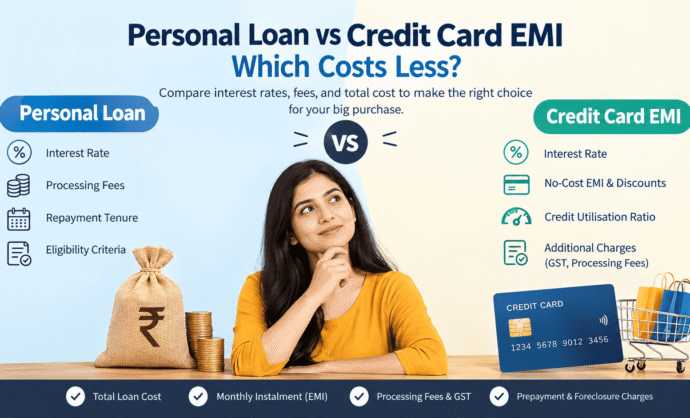
When you need to pay for an expensive purchase, a medical bill, a wedding, or a home renovation, paying the entire amount upfront may not be practical. Two common options are taking a personal loan or converting a purchase into credit card EMI. Both allow you to spread payments over several months, but they can differ significantly in interest, fees, repayment flexibility, and overall cost.
So, personal loan vs credit card EMI: which costs less?
In many cases, a personal loan can be more economical for larger expenses and longer repayment periods, especially when you qualify for a competitive interest rate. However, a credit card EMI may be a better choice for smaller purchases when a genuine no-cost EMI offer is available and the associated fees are low.
The important thing is not to choose an option simply because its monthly instalment looks affordable. You need to compare the interest payable, processing fees, GST, repayment tenure, and total amount you will pay by the end of the loan.
This guide explains how both options work, compares their costs with an illustrative example, and helps you decide which one may suit your financial situation.
Personal Loan vs Credit Card EMI: Understanding the Difference
Before comparing costs, it helps to understand how these two borrowing options work.
What is a personal loan?
A personal loan is an unsecured loan offered by a bank or non-banking financial company (NBFC). You receive a specified amount and repay it through fixed monthly instalments over an agreed period.
Because most personal loans are unsecured, you generally do not need to provide collateral such as property or gold. The lender assesses your income, credit history, existing financial commitments, and repayment capacity before approving the application.
For example, suppose you need ₹1,00,000 to cover a wedding expense or pay for an urgent home repair. You could apply for a personal loan, receive the approved amount, and repay it through EMIs over 12, 24, or another available number of months.
The money can generally be used for permitted personal expenses, subject to the lender’s terms.
Key features of a personal loan:
A personal loan may be particularly useful when you need a relatively large amount or want a structured repayment schedule.
What is credit card EMI?
Credit card EMI allows you to pay for an eligible purchase in instalments instead of paying the entire amount in one billing cycle.
Depending on the card issuer, you may be able to select EMI at checkout or convert an eligible transaction into instalments after making the purchase.
For example, if you buy a laptop worth ₹60,000, your bank may allow you to convert the transaction into a six- or twelve-month EMI plan. You then repay the amount through your credit card statement according to the issuer’s terms.
Credit card EMI is convenient because you may not need to submit a separate personal loan application. However, convenience does not automatically mean a lower cost.
Key features of credit card EMI:
Credit card EMI can work well for planned purchases when the offer is competitive. For larger expenses, however, you should compare it with a personal loan before making a decision.
Personal loan vs credit card EMI: Quick comparison
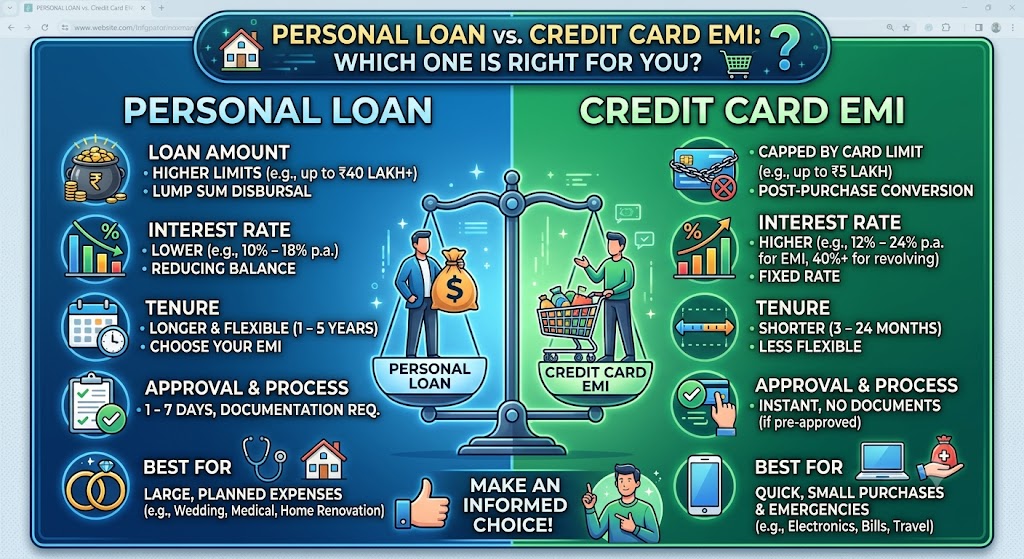
| Factor | Personal loan | Credit card EMI |
|---|---|---|
| Main purpose | Borrow money for eligible personal expenses | Convert an eligible card purchase into instalments |
| Application | A loan application and lender assessment are usually required | May be available through an existing eligible card |
| Interest rate | Depends on lender and borrower profile | Depends on the card issuer, transaction and EMI plan |
| Processing fees | May apply | May apply |
| GST | Applicable to taxable charges | Applicable to taxable interest and charges |
| Repayment tenure | Depends on the lender’s available loan terms | Depends on the issuer’s EMI options |
| Credit limit | Does not generally use a credit card limit | Can reduce available card credit |
| Early repayment | Depends on the loan agreement | Depends on the card issuer’s EMI terms |
| Potential advantage | Useful for larger borrowing needs | Convenient for eligible purchases and promotional offers |
The most suitable option depends on the actual terms offered to you, not just the product name.
Interest is one of the most important factors when comparing these two options. However, looking only at the advertised annual interest rate can give you an incomplete picture.
Your final borrowing cost depends on the interest rate, how the lender calculates interest, the repayment schedule, and any additional charges.
Which option generally has a lower interest rate?
Personal loans can offer competitive interest rates to borrowers with strong credit profiles, stable income, and manageable existing debt. Credit card EMI rates vary by issuer, transaction type, promotional scheme, and tenure.
A regular credit card EMI may cost more than a competitive personal loan. But this is not guaranteed: a special EMI offer or a personal loan with a high rate and substantial fees can change the result.
When comparing offers, ask each lender for the annual interest rate, repayment schedule, and applicable charges. Where available, review the annual percentage rate (APR), which helps you understand the annualised cost of borrowing, including specified charges.
Do not assume that a monthly rate can be compared directly with an annual rate without converting the figures correctly.
Example: Borrowing ₹1,00,000 for 12 months
Consider the following hypothetical offers:
These are illustrative assumptions, not current offers from any particular bank.
| Cost component | Personal loan | Credit card EMI |
|---|---|---|
| Amount borrowed or financed | ₹1,00,000 | ₹1,00,000 |
| Assumed annual interest rate | 14% | 18% |
| Approximate monthly EMI | ₹8,979 | ₹9,168 |
| Approximate total interest | ₹7,750 | ₹10,016 |
| Processing fee before GST | ₹1,000 | ₹1,000 |
| GST on processing fee | ₹180 | ₹180 |
| Illustrative GST on interest | Not included in this example | ₹1,803 |
| Approximate total cost above principal | ₹8,930 | ₹12,999 |
| Approximate total amount paid | ₹1,08,930 | ₹1,12,999 |
Figures are estimates based on standard monthly reducing-balance EMI calculations and rounded values. The personal loan illustration excludes GST on interest, which is generally not charged as a separate tax on the interest component of an ordinary personal loan; the tax treatment of specific charges should be checked. Actual bank calculations, fee structures, taxes, and rounding may differ.
In this example, the personal loan costs approximately ₹4,069 less over 12 months. The difference arises from the assumed interest rates and the additional GST on credit card EMI interest.
The lesson is simple: compare the complete repayment cost, not just the monthly EMI or headline interest rate.
Why the interest calculation method matters
Some financing offers advertise a flat interest rate, while others calculate interest on the outstanding principal.
With a reducing-balance loan, interest is calculated on the principal that remains unpaid after each instalment. As you repay the principal, the interest component generally decreases.
A flat-rate calculation applies interest to the original principal throughout the specified period. As a result, a flat rate can appear lower than the equivalent reducing-balance rate while producing a higher overall cost than expected.
Before accepting an offer, confirm whether the interest rate is flat or reducing-balance, and request the full amortisation schedule.
This is particularly important when comparing different lenders or promotional EMI plans.
Total Loan Cost and Total Amount Payable: Look Beyond the EMI
A lower monthly payment can make borrowing feel affordable. However, it does not necessarily mean you will spend less overall.
To understand the real cost, calculate the total amount you will pay throughout the repayment period.
What makes up the total cost of borrowing?
Your total loan cost may include:
Not every charge applies to every loan. The important step is to obtain a written breakdown from the lender before committing.
For a simple comparison, use this formula:
Total borrowing cost = Total amount paid − Original principal
The total amount paid should include all EMIs and any additional charges you pay separately.
Why a longer repayment tenure can cost more
Suppose you borrow ₹1,00,000. One lender offers a repayment period of 12 months, while another offers 24 months.
The longer tenure generally reduces the monthly EMI because the repayment is spread across more months. However, if the interest rate and other terms are comparable, you will usually pay interest for a longer period.
This means the total interest payable may increase even though the monthly payment becomes more manageable.
Consider someone who chooses a two-year loan because the EMI appears easier to afford. If the same person could comfortably repay a one-year loan, the shorter option might save money on interest.
However, choosing an EMI that is too high can create a different problem: missed payments, late fees, and financial stress. A lower total cost is useful only when the repayment schedule is realistic.
The right balance is to choose the shortest tenure you can comfortably afford while maintaining enough money for essential expenses and emergencies.
Check processing fees and GST charges
Processing fees are easy to overlook because they are often deducted from the loan disbursal or charged separately.
For example, if you borrow ₹1,00,000 and pay a 1% processing fee plus 18% GST on that fee, the cost is ₹1,180.
If the lender deducts this amount before disbursing the loan, you may receive less than ₹1,00,000 even though you must repay the full principal.
Credit card EMI plans can also include a processing fee. Depending on the issuer, the fee may be charged at the time of conversion or included in the card statement.
Do not assume that every EMI plan follows the same fee structure. Check the card issuer’s terms for processing fees, applicable taxes, cancellation rules, and early closure charges.
Are no-cost EMI and merchant discounts really free?
No-cost EMI is a promotional financing arrangement in which the advertised interest cost may be offset by a merchant discount, an upfront discount, or another offer structure.
For example, a retailer may offer a product for ₹50,000 with a standard payment option or a no-cost EMI option. Under the EMI offer, the interest component may be offset through a discount or subvention arrangement.
However, you should not automatically assume that the no-cost EMI option is the cheapest.
Check whether:
Imagine that a product costs ₹50,000, but a retailer offers a ₹2,000 upfront discount for full payment. The EMI option has no advertised interest but does not provide that discount and includes a processing fee.
In that case, the EMI option may cost more than paying upfront, even though it is marketed as no-cost EMI.
Always compare the final payable amount under each available option. The best deal is the one with the lowest overall cost, provided the payment method suits your cash flow.
Use an EMI calculator before you borrow
An EMI Calculator and Monthly Instalment estimate can help you compare borrowing options before applying.
To calculate a standard reducing-balance EMI, you need three inputs:
The formula is:
EMI = P × r × (1 + r)ⁿ ÷ [(1 + r)ⁿ − 1]
Here, P is the principal, r is the monthly interest rate, and n is the number of monthly instalments.
For example, if you borrow ₹1,00,000 at a 14% annual reducing-balance interest rate for 12 months, the calculator estimates the monthly instalment and total interest based on those inputs.
Repeat the calculation for the credit card EMI offer using its interest rate and tenure. Then add processing fees, applicable GST, and other charges to both results.
Remember that a standard EMI calculator does not automatically account for every bank fee, promotional discount, tax, or card-specific rule. Use the calculator for an initial estimate and the lender’s repayment schedule for the final comparison.
Cost is not the only consideration when deciding between a personal loan and credit card EMI. Your existing debt, available credit limit, repayment history, and ability to meet monthly commitments also matter.
Credit utilisation ratio and credit score impact
Your credit utilisation ratio measures how much of your available revolving credit you are using. It is commonly calculated by dividing your outstanding credit card balance by your total available credit limit and multiplying by 100.
For example, suppose your credit card has a limit of ₹2,00,000 and you convert a ₹1,00,000 purchase into EMI. If the entire financed amount continues to count against your available limit, your utilisation could initially reach 50%, before accounting for other balances or subsequent repayments.
A high credit utilisation ratio can negatively affect your credit profile, although the exact impact depends on the credit scoring model and the information reported by your lender.
Credit card EMI does not necessarily damage your credit score. Paying on time and managing your overall borrowing responsibly are important. However, a large EMI balance can reduce the credit available for emergencies or other purchases.
A personal loan works differently. It does not ordinarily occupy your credit card limit, although the new loan and its EMI can affect your overall debt obligations and how future lenders assess your repayment capacity.
Neither option guarantees a better credit score. Missing payments, carrying excessive debt, or applying for multiple loans within a short period can create problems.
Practical tip: Before taking either option, check your current card balances, available limits, existing EMIs, and upcoming financial commitments. Avoid using most of your credit limit simply because a lender allows you to do so.
Eligibility criteria, credit history and loan amount
Your eligibility can influence which option is available and how much it costs.
For a personal loan, lenders may consider:
A strong credit history and stable income may help you qualify for a more competitive interest rate, but approval and pricing remain at the lender’s discretion.
Credit card EMI usually depends on whether the transaction is eligible, your available credit limit, your card account status, and the issuer’s approval rules. Some issuers may also evaluate your repayment record and account behaviour.
Consider a borrower who has a credit card with a ₹75,000 available limit but needs ₹1,20,000 for a home repair. A card EMI may not cover the entire purchase if the available limit is insufficient. A personal loan could potentially provide the required amount if the borrower meets the lender’s eligibility criteria.
On the other hand, someone with an eligible purchase and sufficient card limit may be able to convert the transaction into EMI without completing a separate loan application.
Do not apply for a personal loan solely because the required amount exceeds your card limit. First assess whether the proposed EMI fits your budget and whether borrowing the full amount is necessary.
Prepayment and foreclosure charges
Your financial situation may improve before the loan ends. You might receive a bonus, a salary increase, or extra income that allows you to repay the outstanding balance early.
This is where prepayment and foreclosure charges become important.
Part-prepayment means repaying some of the outstanding principal before the scheduled date. Foreclosure generally means closing the loan completely before the original tenure ends.
Some lenders permit early repayment without a charge under specified conditions. Others may apply fees or restrictions depending on the product, agreement, and applicable regulations.
Credit card EMI plans can also have early closure charges, and cancelling a booked EMI may involve separate conditions.
Before choosing either option, ask:
For example, suppose you take a loan with a 24-month tenure but expect to repay it in 12 months. A loan with a slightly higher interest rate but no applicable foreclosure charge might work out cheaper than a lower-rate loan with substantial early closure costs.
The only reliable way to decide is to compare the expected total cost under your actual repayment plan.
What happens if you miss an EMI?
Missing a payment can make either borrowing option more expensive.
A missed personal loan EMI may attract late-payment charges, additional interest where contractually applicable, and negative credit reporting. Repeated defaults can damage your credit profile and make future borrowing more difficult.
For credit card EMI, the instalment is generally billed through the credit card account. Failing to pay the required statement amount may trigger applicable late fees, interest, and other consequences under the card’s terms. Unpaid balances can also affect your available credit.
Do not confuse paying the minimum amount due with clearing the entire statement. The minimum amount is not a repayment strategy that makes outstanding borrowing inexpensive. Interest may continue to accrue on unpaid balances, subject to the issuer’s terms and applicable rules.
If you believe you will struggle with an upcoming payment, contact the lender before the due date. Ask about the available options rather than ignoring the bill or taking another expensive loan to cover it.
The best borrowing decision starts with an EMI you can pay reliably, even if an unexpected expense arises.
When Should You Choose a Personal Loan or Credit Card EMI?
There is no single answer for every borrower. The best option depends on the amount you need, the available interest rate, the tenure, fees, and your financial situation.
Choose a personal loan when the overall cost is lower
A personal loan may be worth considering in the following situations:
1. You need a larger amount.
Expenses such as home repairs, wedding costs, or several necessary purchases may exceed your available credit card limit. A personal loan can provide a lump sum, subject to approval and eligibility.
2. You need a longer repayment period.
If a personal loan offers a suitable tenure and a competitive reducing-balance rate, it may provide a more affordable way to repay a large expense over time. Remember that a longer tenure can still increase total interest.
3. The personal loan has lower total charges.
If the interest rate is competitive and the processing fee is reasonable, a personal loan may cost less than a regular credit card EMI. Compare the full repayment schedules before deciding.
4. You want to keep your credit card limit available.
A personal loan generally does not block your credit card limit in the same way that an outstanding card EMI may. This can help preserve card capacity for planned purchases or genuine emergencies.
5. You need money rather than financing for one purchase.
A personal loan may be more appropriate when you need funds to pay several eligible expenses instead of converting a single transaction into EMI.
A personal loan is not automatically the better option, though. Check the total cost and avoid borrowing more than you need.
Choose credit card EMI when convenience or a genuine offer makes sense
Credit card EMI can be suitable in other circumstances.
1. You have a small or moderate purchase.
If the transaction is eligible and the EMI terms are competitive, converting the purchase may be simpler than applying for a separate personal loan.
2. You qualify for a genuine no-cost EMI offer.
A promotional plan may be attractive if the final product price, lost discounts, processing fee, GST, and other charges compare favourably with alternative payment methods.
3. You need a shorter repayment period.
A short-term card EMI may work for a planned purchase if its total cost is lower than the available personal loan alternative and you can comfortably meet each payment.
4. You already have an eligible credit card.
An existing card can make the process convenient, although the issuer must approve the transaction or conversion. Convenience should not override a careful cost comparison.
5. You can manage your existing credit obligations.
If the new EMI does not leave you with excessive utilisation or an unmanageable monthly commitment, it may fit into your financial plan.
Never select an EMI just because it is offered at checkout. Review the terms before confirming the transaction.
What if you can pay the credit card bill in full?
If you can comfortably pay for the purchase from available savings without compromising your emergency fund, compare the cost of paying upfront against borrowing.
Paying in full can avoid borrowing interest, although you may give up a promotional benefit or reward in some cases. Keep enough money available for essential expenses and emergencies rather than draining your savings for a non-essential purchase.
If you already made a credit card purchase and can pay the full statement balance by the due date, you may benefit from the card’s interest-free period, subject to the issuer’s rules and the account’s payment status.
If you cannot clear the balance, do not assume that carrying it forward is equivalent to choosing a structured EMI. Revolving credit card interest can be considerably more expensive than a competitively priced personal loan or an approved EMI plan.
Compare the available alternatives before the unpaid balance becomes a longer-term burden.
These FAQs are written for your SEO article targeting Indian users. They cover interest rates, EMI calculations, fees, GST, credit scores, eligibility, repayment, and no-cost EMI.
1. Which is cheaper, a personal loan or credit card EMI?
A personal loan may be cheaper if it offers a lower interest rate and reasonable processing fees. However, a genuine low-cost or no-cost credit card EMI offer may be more economical for eligible purchases. Compare the total amount payable before deciding.
2. What is the difference between a personal loan and credit card EMI?
A personal loan provides a lump sum that you repay through scheduled instalments. Credit card EMI converts an eligible purchase into instalments charged through your credit card account.
3. Is a personal loan better than credit card EMI?
A personal loan may suit larger expenses and longer repayment periods, while credit card EMI may be convenient for smaller purchases. The better option depends on the interest rate, fees, repayment tenure, and your financial situation.
4. Which has a lower interest rate, a personal loan or credit card EMI?
Interest rates vary by lender, borrower profile, card issuer, and offer. Compare the actual annual interest rate and repayment schedule rather than assuming one product is always cheaper.
5. Should I choose a personal loan or credit card EMI for a big purchase?
Compare both options using the same principal amount and repayment period. Include interest, processing fees, applicable GST, and any discounts you may lose before choosing.
6. How do I compare personal loan and credit card EMI interest rates?
Check the annual interest rate, whether it is flat or reducing-balance, the repayment tenure, and the applicable fees. Use the lender’s repayment schedule to calculate the total cost.
7. What is a reducing-balance interest rate?
A reducing-balance rate calculates interest on the outstanding principal. As you repay the principal, the amount on which interest is calculated generally decreases.
8. What is the difference between flat interest and reducing-balance interest?
Flat interest is calculated on the original principal throughout the specified period, whereas reducing-balance interest is calculated on the remaining principal. A flat rate can therefore appear lower while producing a higher effective borrowing cost.
9. Does a lower interest rate always mean a cheaper loan?
No. Processing fees, taxes, repayment tenure, foreclosure charges, and other applicable costs can make a loan with a lower advertised rate more expensive overall.
10. What is the total cost of a personal loan?
The total cost includes the interest paid and any applicable processing fees, taxes, and other charges. Add these costs to the principal to calculate the total amount payable.
11. What is the total cost of credit card EMI?
It includes the financed purchase amount, applicable EMI interest, processing fees, GST on taxable charges, and other fees that apply under the card issuer’s terms.
12. How can I calculate the total amount payable on an EMI?
Multiply the monthly EMI by the number of instalments and add any charges paid separately. If the EMI includes certain fees, avoid counting those fees twice.
13. Can a personal loan cost less than credit card EMI over 12 months?
Yes. If the personal loan has a lower effective interest rate and lower overall charges, it may cost less over 12 months. Compare the actual offers to confirm the difference.
14. Is credit card EMI more expensive than a personal loan for 24 months?
It can be, particularly if the card EMI has a higher interest rate or additional charges. However, the outcome depends on the actual rates, fees, and repayment terms.
15. What is APR in a personal loan or credit card EMI?
APR stands for annual percentage rate. It expresses borrowing costs on an annualised basis and can help compare offers when calculated using consistent assumptions and applicable charges.
16. How do I calculate my monthly EMI?
Use an EMI calculator and enter the principal, annual interest rate, and repayment tenure. For a complete comparison, add applicable fees and taxes to the calculated repayment cost.
17. Does a longer loan tenure reduce the total interest?
Usually not. A longer tenure generally reduces the monthly EMI but increases the total interest paid when the rate and other terms are comparable.
18. Is a shorter repayment tenure always better?
A shorter tenure usually reduces total interest, but the monthly EMI is higher. Choose a tenure that balances interest savings with your ability to make payments comfortably.
19. What is an amortisation schedule?
An amortisation schedule shows how each EMI is divided between principal and interest, along with the outstanding loan balance after each payment.
20. Can I use the same EMI calculator for a personal loan and credit card EMI?
Yes, for an initial comparison if both use a standard reducing-balance calculation. You must separately account for product-specific fees, GST, promotional discounts, and other charges.
21. How much EMI will I pay on a ₹1 lakh personal loan?
The EMI depends on the interest rate and tenure. For example, a ₹1 lakh loan at an assumed 14% annual reducing-balance rate for 12 months has an estimated EMI of approximately ₹8,979, excluding fees.
22. How much EMI will I pay on a ₹50,000 credit card purchase?
The EMI depends on the card issuer’s interest rate, available tenure, and offer terms. Enter the financed amount and actual rate into an EMI calculator, then include applicable fees and taxes.
23. Can I reduce my EMI without taking another loan?
You can ask your lender whether a different repayment tenure or another repayment arrangement is available. A longer tenure may reduce the EMI but can increase the total interest, so compare the revised total cost.
24. What happens if I miss a personal loan EMI?
You may face late-payment charges, additional interest where applicable, and negative credit reporting. Repeated missed payments can make future borrowing more difficult.
25. What happens if I miss a credit card EMI payment?
The unpaid amount may attract applicable late fees and interest under the card agreement. Your credit profile may also be affected, and your available credit could remain restricted.
26. Do personal loans have processing fees?
Many lenders charge a processing fee, although the amount and conditions vary. Check whether the fee is deducted from the disbursal amount or charged separately.
27. Does credit card EMI have processing fees?
Some credit card EMI plans charge a processing fee, while others may waive it under specific offers. Check the issuer’s terms before converting a transaction.
28. Is GST charged on personal loan interest?
Ordinary personal loan interest is generally exempt from GST, but taxable fees and services associated with the loan may attract GST. Verify the lender’s fee breakdown.
29. Is GST charged on credit card EMI interest?
GST generally applies to interest or financing charges on credit card services, subject to the applicable tax rules. Check the issuer’s statement and terms for the actual charges.
30. Is no-cost EMI really free?
Not always. Interest may be offset through a merchant discount or promotional arrangement, but processing fees, GST, lost discounts, or foregone rewards may still make the offer more expensive.
31. Is no-cost EMI better than a personal loan?
It may be better for an eligible purchase if the final payable amount is lower than the personal loan alternative. Compare the product price, fees, taxes, and available discounts.
32. Do I lose discounts when I choose credit card EMI?
Possibly. Some merchants provide different discounts or cashback depending on the payment method. Compare the final price under each option before placing the order.
33. Can credit card EMI include hidden charges?
Charges may be overlooked rather than hidden. Review the processing fee, applicable GST, interest, cancellation conditions, late fees, and early closure terms before accepting the offer.
34. Is a personal loan cheaper than paying only the minimum amount due on a credit card?
A competitively priced personal loan may cost less than carrying an unpaid credit card balance at a high revolving interest rate. Compare the new loan’s total cost and ensure you can afford the repayments.
35. Can I convert an existing credit card transaction into EMI?
Some card issuers allow eligible purchases to be converted after the transaction, subject to minimum amounts, conversion deadlines, account status, and other conditions. Confirm availability with your issuer.
36. Does credit card EMI affect my credit score?
It can affect your credit profile through utilisation, reported balances, and repayment behaviour. Paying on time and managing debt responsibly are important.
37. Does a personal loan improve my credit score?
A personal loan does not automatically improve your score. Consistent repayments may support a positive credit history, while missed payments and excessive borrowing can harm your credit profile.
38. What is the credit utilisation ratio?
It is the percentage of your available revolving credit that you are using. It is commonly calculated by dividing your outstanding credit card balance by your total credit limit and multiplying by 100.
39. Does credit card EMI reduce my available credit limit?
It can. The outstanding EMI principal may continue to occupy part of your credit limit, depending on the issuer’s rules and repayment arrangements.
40. Which option is better for maintaining a low credit utilisation ratio?
A personal loan generally does not use your credit card limit in the same way as credit card EMI. However, a personal loan still adds to your debt obligations, which lenders may consider when assessing new credit applications.
41. What are the eligibility criteria for a personal loan?
Lenders commonly assess income, employment stability, age, credit history, existing obligations, and repayment capacity. Exact requirements vary by lender and product.
42. Can I get credit card EMI with a low credit score?
Approval depends on the card issuer’s rules, your account status, available credit limit, and transaction eligibility. A low score or poor repayment history may affect your access to credit.
43. Which option is better if I have a low income?
Neither option is automatically suitable. Compare the EMI with your essential expenses, existing debt, and emergency savings. If the payment would strain your budget, consider a cheaper purchase or delaying the expense.
44. Should I take a personal loan to pay off credit card debt?
It may make sense if the personal loan has a lower total borrowing cost and a manageable repayment schedule. Avoid building up new credit card debt after consolidation.
45. Can I repay a personal loan early?
Some lenders allow part-prepayment or foreclosure, subject to their terms and applicable rules. Check any minimum holding period, charges, and potential interest savings before closing early.
46. Can I close credit card EMI before the tenure ends?
Some issuers allow early closure, but foreclosure charges or other conditions may apply. Ask the issuer for the outstanding amount and total closure cost before proceeding.
47. Which is better for emergency expenses: personal loan or credit card EMI?
It depends on the urgency, amount required, available credit, and actual borrowing costs. Compare eligible options and preserve enough money for essential expenses rather than taking on unaffordable debt.
48. Is a personal loan better for wedding or home renovation expenses?
A personal loan may be convenient for larger expenses involving multiple payments. However, compare the interest rate, fees, tenure, and total repayment against any available credit card EMI offers.
49. Can I get both a personal loan and credit card EMI at the same time?
You may be able to use both if you meet the relevant eligibility and account requirements. However, carrying multiple repayments increases your financial obligations and may affect your ability to qualify for future credit.
50. How do I decide between a personal loan and credit card EMI?
Compare the actual interest rate, EMI, repayment tenure, processing fees, applicable GST, total amount payable, credit utilisation impact, and early repayment conditions. Choose the option that meets your needs at the lowest reasonable total cost and fits comfortably within your budget.
Also Read: How EMI Is Calculated in India
How EMI Is Calculated in India: A Complete Guide Tak...
EMI Calculator: Calculate Your Monthly Loan EMI, Intere...