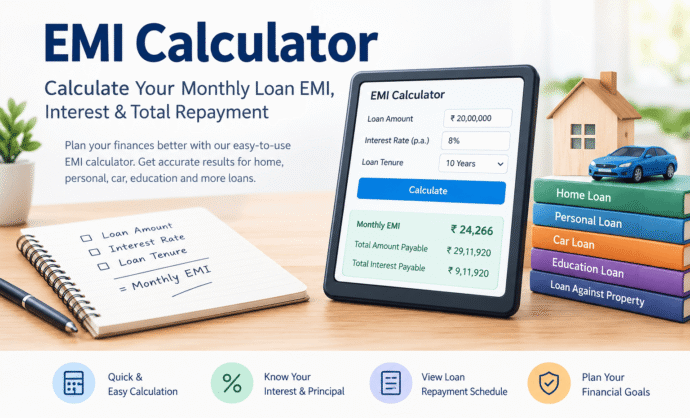
EMI Calculator: Calculate Your Monthly Loan EMI, Interest & Repayment
Taking a loan is a major financial commitment. Whether you are buying a home, purchasing a car, funding higher education, or managing an unexpected expense, one question usually comes first: “How much will I have to pay every month?”
An EMI Calculator makes it easier to answer that question before you apply for a loan. By entering a few basic details such as the Loan Amount / Principal Amount, Interest Rate (p.a.), and Loan Tenure / Repayment Period, you can estimate your Monthly EMI Payment, Total Interest Payable, and Total Amount Payable.
But an EMI calculator is more than just a tool for finding a monthly payment. Used properly, it can help you compare loan options, understand the real cost of borrowing, plan your budget, evaluate EMI Affordability, and understand how prepayments or changes in interest rates could affect your repayment.
For example, imagine you are planning to buy a ₹50 lakh home. A lender may tell you that you are eligible for the loan, but eligibility does not necessarily mean the EMI will comfortably fit into your monthly budget. By changing the tenure and interest rate in an EMI calculator, you can see how different borrowing scenarios affect your finances before making a long-term commitment.
This guide explains how an EMI calculator works, how the EMI Calculation Formula is used, how different loan types affect repayment, and how concepts such as Interest Accrual, Loan Repayment Schedule, EMI Breakup, Partial Loan Prepayment, and Home Loan Balance Transfer can influence your overall borrowing cost.
What Is an EMI Calculator and How Does It Work?
EMI stands for Equated Monthly Installment. It is the periodic payment a borrower makes toward repaying a loan.
For a typical amortizing loan, an EMI contains two major components:
- Principal repayment
- Interest payment
At the beginning of a loan, a relatively larger portion of the EMI may go toward interest. As the outstanding principal decreases, the interest component generally falls and a greater portion of subsequent payments goes toward principal.
An EMI Calculator uses the loan amount, applicable interest rate, and repayment period to estimate this monthly payment.
Three Main Inputs Required
Most EMI calculators require three basic inputs.
1. Loan Amount / Principal Amount
This is the amount you plan to borrow. For example, if a property costs ₹60 lakh and you make a ₹10 lakh down payment, your initial loan requirement could be ₹50 lakh, subject to lender eligibility and other conditions.
A larger principal generally means a larger EMI when the interest rate and tenure remain unchanged.
2. Interest Rate (p.a.)
The interest rate represents the cost of borrowing. It is commonly displayed as an annual percentage rate.
For example, if a lender offers a loan at 8% per annum, the EMI calculation needs to account for the applicable periodic interest rate.
Even a small difference in interest rate can make a meaningful difference to the total interest paid over a long repayment period.
3. Loan Tenure / Repayment Period
The Loan Tenure / Repayment Period is the length of time over which the loan will be repaid.
It may be expressed in months or years.
Generally:
- Shorter tenure → higher EMI but lower total interest
- Longer tenure → lower EMI but higher total interest
This is why you should not select a loan tenure based only on the lowest possible monthly payment.
How Is EMI Calculated?
The standard EMI Calculation Formula for a reducing-balance loan is:
EMI = P × r × (1 + r)ⁿ / [(1 + r)ⁿ − 1]
Where:
- P = Principal or loan amount
- r = Periodic interest rate
- n = Total number of instalments
For a monthly EMI calculation, the annual interest rate is generally converted into a monthly rate, and the tenure is converted into the number of monthly instalments.
Although the formula may look complicated, an EMI calculator performs this calculation instantly.
Example of EMI Calculation
Suppose you borrow:
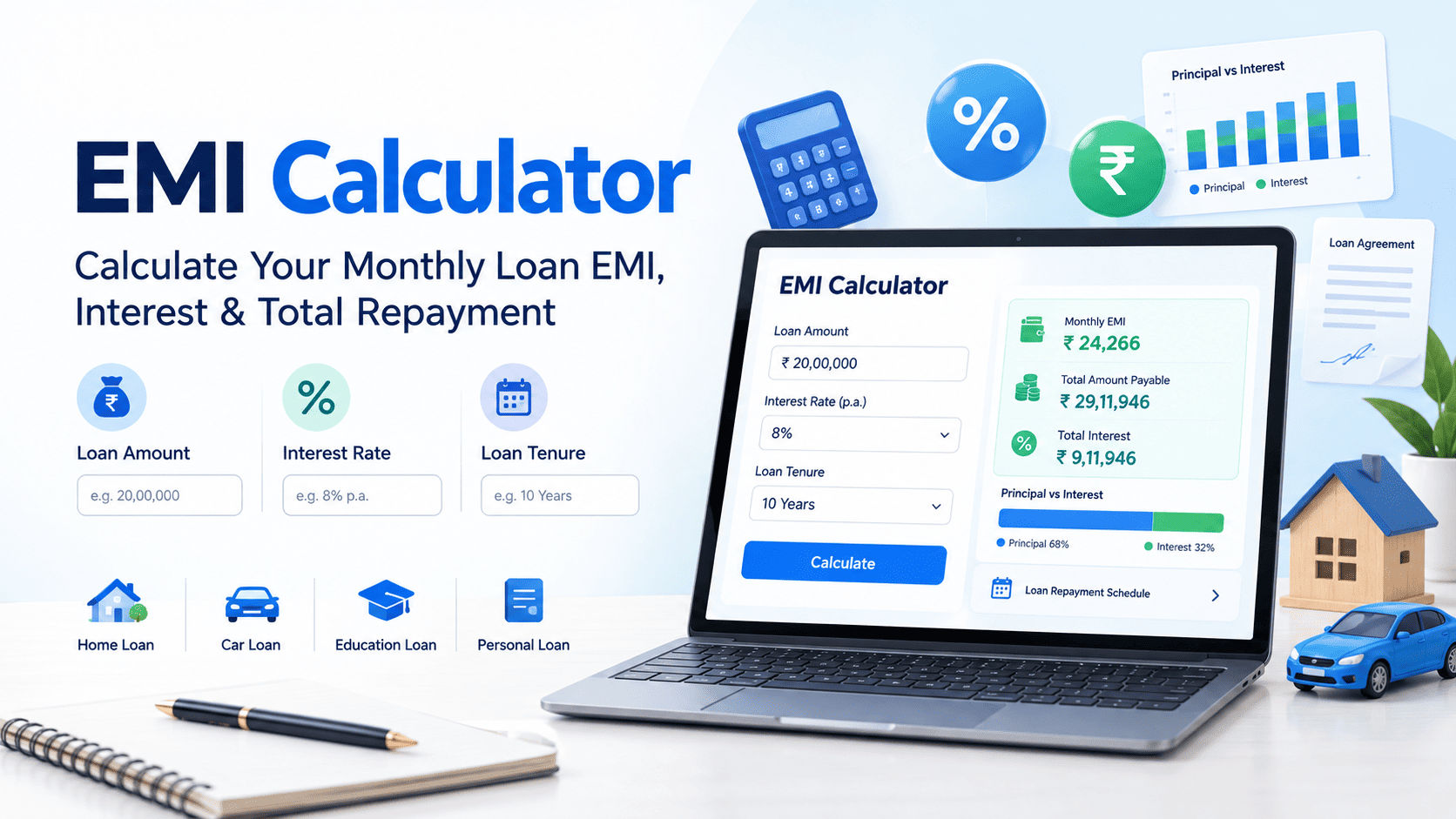
- Loan amount: ₹20,00,000
- Interest rate: 8% per annum
- Tenure: 10 years
Instead of manually applying the formula, you can enter these values into an EMI calculator. The calculator will estimate your monthly EMI and can also show the total repayment and interest payable.
The important point is that the EMI itself does not tell the complete story.
Two loans can have similar monthly payments but very different total costs because of differences in interest rates, tenure, fees, or repayment structures.
Understanding EMI Breakup and Loan Repayment Schedule
One of the most useful features of an EMI calculator is the ability to understand your EMI Breakup.
Your monthly payment is generally divided between:
Principal component + Interest component = EMI
Suppose your EMI is ₹25,000.
Part of that ₹25,000 may be used to cover the interest accrued during the month, while the remaining amount reduces the outstanding principal.
Over time, the composition of the EMI changes.
What Is Interest Accrual?
Interest Accrual refers to the interest that accumulates on the outstanding loan balance over a specific period.
For a reducing-balance loan, interest is generally calculated based on the outstanding principal rather than the original loan amount throughout the entire tenure.
This creates an important pattern.
During the early years:
Outstanding principal is relatively high → interest component is relatively high.
Later in the loan:
Outstanding principal falls → interest component generally falls.
As a result, more of the EMI can go toward reducing the principal as the loan progresses.
What Is a Loan Repayment Schedule?
A Loan Repayment Schedule provides a payment-by-payment view of your loan.
It may show:
| Payment |
EMI |
Principal |
Interest |
Outstanding Balance |
| 1 |
₹X |
₹X |
₹X |
₹X |
| 2 |
₹X |
₹X |
₹X |
₹X |
| 3 |
₹X |
₹X |
₹X |
₹X |
The exact figures depend on the loan amount, interest rate, tenure, and lender’s calculation methodology.
This schedule is particularly useful when you want to understand how quickly your outstanding balance is decreasing.
Working EMI Example: ₹20 Lakh Loan at 8% for 10 Years
Let’s see how an EMI calculator works with a practical example.
Suppose you borrow ₹20,00,000 at an annual interest rate of 8% for a 10-year repayment period.
Step 1: Identify the inputs
- Loan Amount (P): ₹20,00,000
- Interest Rate: 8% per annum
- Loan Tenure: 10 years
- Number of monthly instalments (n): 10 × 12 = 120 months
- Monthly interest rate (r): 8% ÷ 12 ÷ 100 = 0.006667
Step 2: Apply the EMI formula
The standard formula is:
EMI = P × r × (1 + r)ⁿ ÷ [(1 + r)ⁿ − 1]
Substituting the values:
EMI = ₹20,00,000 × 0.006667 × (1.006667)¹²⁰ ÷ [(1.006667)¹²⁰ − 1]
The resulting Monthly EMI Payment is approximately ₹24,266.
Step 3: Calculate the total repayment
You will make 120 monthly payments.
Total Amount Payable = ₹24,266 × 120
Total Amount Payable ≈ ₹29,11,920
Step 4: Calculate total interest
The original principal was ₹20,00,000.
Therefore:
Total Interest Payable ≈ ₹29,11,920 − ₹20,00,000
Total Interest Payable ≈ ₹9,11,920
What does this example tell you?
For a ₹20 lakh loan at 8% for 10 years:
| Loan detail |
Approximate amount |
| Loan amount |
₹20,00,000 |
| Interest rate |
8% p.a. |
| Tenure |
10 years |
| Monthly EMI |
₹24,266 |
| Number of EMIs |
120 |
| Total amount payable |
₹29,11,920 |
| Total interest |
₹9,11,920 |
This example demonstrates why you should look beyond the EMI alone. A ₹24,266 monthly payment may appear manageable, but over 10 years you would pay approximately ₹9.12 lakh in interest in addition to the ₹20 lakh principal.
What happens if you change the tenure?
Now imagine keeping the same ₹20 lakh loan and 8% interest rate but extending the tenure to 20 years.
Your monthly EMI would generally become lower, but you would make twice as many monthly payments. As a result, the Total Interest Payable would increase substantially.
This illustrates one of the most important principles of loan planning:
Shorter tenure generally means higher EMI but lower total interest, while longer tenure generally means lower EMI but higher total interest.
An EMI calculator lets you test these scenarios instantly before deciding how much to borrow and how long you want to take to repay it.
Total Amount Payable vs Total Interest Payable
When evaluating a loan, do not look at the EMI alone.
You should also examine:
- Total Interest Payable
- Total Amount Payable
- Applicable processing fees
- Prepayment or foreclosure charges, if applicable
- Other loan-related costs
Total Interest Payable
The Total Interest Payable represents the interest component expected over the scheduled repayment period.
A simplified calculation is:
Total Interest = Total Scheduled EMI Payments − Principal
This does not necessarily include separate charges such as processing fees, insurance, taxes, or other applicable costs.
Total Amount Payable
The Total Amount Payable represents the scheduled amount you will pay through your EMIs over the loan tenure.
For example, suppose your monthly EMI is ₹30,000 and your loan has 120 monthly instalments.
The scheduled EMI repayment would be:
₹30,000 × 120 = ₹36,00,000
If your original principal was ₹25 lakh, the difference represents the scheduled interest component, before considering separate fees and charges.
This is why a lower EMI does not automatically mean a cheaper loan.
How Loan Tenure Changes Your EMI
One of the most important decisions when taking a loan is choosing the repayment period.
Consider a hypothetical ₹30 lakh loan at the same interest rate.
You could potentially structure it over:
- 10 years
- 15 years
- 20 years
- 25 years
The longer tenure generally reduces the monthly EMI.
That sounds attractive.
However, the loan remains outstanding for a longer period, which generally means you pay interest for more instalment periods.
Short Tenure
Advantages:
- Faster repayment
- Lower total interest
- Principal reduces faster
Disadvantages:
- Higher monthly EMI
- Greater pressure on monthly cash flow
Long Tenure
Advantages:
- Lower monthly EMI
- Easier short-term cash-flow management
- May improve affordability based on monthly income
Disadvantages:
- Higher total interest
- Slower principal reduction
- Longer financial commitment
The right tenure depends on your income, expenses, financial goals, existing obligations, and repayment capacity.
EMI Affordability: How Much EMI Can You Actually Handle?
A lender may determine Loan Eligibility based on several factors, but your maximum eligible loan amount should not automatically be treated as your ideal borrowing amount.
This is where EMI Affordability becomes important.
Suppose two people both earn ₹1 lakh per month.
Person A:
- Rent: ₹20,000
- Existing EMI: ₹15,000
- Household expenses: ₹35,000
- Other commitments: ₹10,000
Person B:
- Rent: ₹10,000
- Existing EMI: ₹5,000
- Household expenses: ₹25,000
- Other commitments: ₹5,000
Although their income is identical, their available cash flow is different.
Therefore, their comfortable EMI levels may also be different.
Debt-to-Income Ratio
The Debt-to-Income Ratio (DTI) is a useful financial concept for assessing debt affordability.
It compares debt obligations with income.
A simplified representation is:
DTI = Monthly Debt Obligations ÷ Monthly Gross Income × 100
For example, if monthly debt obligations are ₹30,000 and gross monthly income is ₹1,00,000:
DTI = 30%
Lenders may use their own eligibility criteria and assessment methods, so DTI should be treated as one factor rather than a universal approval rule.
Before taking a loan, consider:
- Existing EMIs
- Household expenses
- Emergency savings
- Income stability
- Future financial goals
- Insurance requirements
- Potential interest-rate changes
An EMI that looks affordable today should ideally remain manageable if your circumstances change.
How Credit Score Can Affect Loan Costs
Your Credit Score can play an important role in the lending process.
Lenders may consider credit history and other financial information when evaluating a loan application.
Depending on the lender and applicant profile, creditworthiness can influence:
- Loan approval
- Applicable interest rate
- Loan amount
- Repayment terms
A lower interest rate can translate into a lower EMI or lower total interest when other factors remain constant.
However, a credit score is only one part of the overall lending assessment.
Before applying for a major loan, it can be useful to review your credit report, existing debt, repayment history, and outstanding obligations.
EMI Calculator for Different Types of Loans
An EMI calculator can be used for several types of borrowing.
Home Loan EMI Calculator
A Home Loan EMI Calculator is useful when purchasing a house, apartment, or other eligible property.
Home loans can involve substantial principal amounts and long repayment periods. Therefore, even a small change in interest rate or tenure can affect the total borrowing cost.
A home-loan calculation should ideally consider:
- Property price
- Down payment
- Loan amount
- Interest rate
- Loan tenure
- Processing fees
- Applicable charges
- Prepayment terms
You can use the calculator to compare different combinations before discussing the final loan structure with a lender.
Personal Loan EMI Calculator
A Personal Loan EMI Calculator helps estimate the monthly repayment for an unsecured personal loan.
Personal loans can have different rates and repayment periods compared with secured loans.
Before accepting an offer, compare:
- Interest rate
- EMI
- Tenure
- Processing fees
- Total repayment
- Prepayment conditions
A loan with a lower monthly EMI may still cost more if its tenure is significantly longer.
Car Loan EMI Calculator
A Car Loan EMI Calculator helps estimate payments when financing a vehicle.
Start with the expected vehicle price and subtract the down payment to estimate the amount that may need to be financed.
For example:
Vehicle price − Down payment = Approximate financed amount
You can then enter the financed amount, interest rate, and tenure into the calculator.
Remember that the overall cost of owning a vehicle can include expenses beyond the loan itself, such as insurance, fuel, maintenance, taxes, and servicing.
Education Loan EMI Calculator
An Education Loan EMI Calculator can help students and families estimate future repayment obligations.
Education loans can have specific repayment structures, including applicable moratorium periods and lender-specific conditions.
Therefore, borrowers should look beyond the headline EMI and understand:
- When repayment begins
- Whether interest accrues during the moratorium
- Applicable interest rate
- Repayment tenure
- Processing fees
- Total repayment obligation
The actual repayment structure should always be confirmed with the lender.
Loan Against Property EMI Calculator
A Loan Against Property EMI Calculator can be used to estimate repayments for a loan secured against eligible property.
Because these loans involve property as security, borrowers should understand both the repayment obligation and the consequences of failing to meet the agreed terms.
Before borrowing, consider:
- Loan amount
- Interest rate
- Property value
- Loan tenure
- Monthly EMI
- Total interest
- Applicable fees
- Prepayment conditions
Partial Loan Prepayment and EMI Interest Savings
One of the most effective ways to potentially reduce future interest is Partial Loan Prepayment.
Suppose you receive a bonus or have accumulated surplus savings.
Instead of simply continuing with the original repayment schedule, you may have the option to make a lump-sum payment toward the outstanding principal, subject to the lender’s terms.
When principal decreases, future interest calculations can also decrease for a reducing-balance loan.
Example
Imagine that you have:
- ₹25 lakh outstanding principal
- 15 years remaining
- An applicable interest rate of 8%
- A ₹5 lakh lump sum available
If the lender permits a ₹5 lakh partial prepayment, the outstanding principal could fall to approximately ₹20 lakh.
The actual interest savings depend on the timing, rate, remaining tenure, repayment structure, and how the lender applies the prepayment.
What Happens After Prepayment?
Depending on the lender and your chosen option, you may be able to:
Option 1: Reduce EMI
Your monthly payment decreases while the repayment period may remain similar.
Option 2: Reduce Tenure
Your EMI may remain similar while the loan gets paid off sooner.
Reducing tenure can potentially produce greater interest savings because the principal is repaid faster, but the appropriate choice depends on your cash-flow requirements and loan terms.
Prepayment Charges: What Borrowers Should Check
Before making a prepayment, check whether Prepayment Charges apply to your particular loan.
The applicable rules can vary based on:
- Loan type
- Interest-rate structure
- Lender
- Loan agreement
- Timing of repayment
- Applicable regulations
Do not calculate your savings using interest alone.
For example:
Net benefit from prepayment = Potential interest savings − Applicable prepayment costs
Also consider whether using your savings for prepayment would leave you with enough emergency funds.
Paying down debt can reduce interest, but maintaining adequate liquidity is also important.
Home Loan Balance Transfer
A Home Loan Balance Transfer involves moving an outstanding home loan from one lender to another, usually to obtain potentially more favorable terms.
For example, imagine you currently have a home loan with:
- Higher applicable interest rate
- Several years remaining
- Significant outstanding principal
Another lender may offer a lower rate.
At first glance, transferring the loan may appear beneficial.
However, you should compare the complete economics.
Consider:
- Existing outstanding principal
- Remaining tenure
- New interest rate
- New EMI
- Processing fees
- Legal or documentation charges
- Other applicable transfer costs
- Prepayment or foreclosure conditions
The correct comparison is not simply:
Old EMI vs New EMI
Instead, compare the remaining total cost of the existing loan against the total cost of the new loan, including transfer-related expenses.
Loan Moratorium and Its Effect on Repayment
A Loan Moratorium is a period during which scheduled principal repayments may be deferred under specific loan terms.
A moratorium does not necessarily mean that interest stops accumulating.
Depending on the loan structure, interest may continue to accrue during the moratorium period.
For this reason, borrowers should ask the lender:
- Does interest accrue during the moratorium?
- Is the accrued interest capitalized?
- When does regular EMI repayment begin?
- Does the moratorium increase the total repayment?
- How does the moratorium affect the repayment schedule?
Never assume that a payment holiday means a completely interest-free period.
Outstanding Loan Balance: Why It Matters
The Outstanding Loan Balance is the principal amount that remains to be repaid.
It is one of the most important numbers for an existing borrower.
Knowing your outstanding balance helps you evaluate:
- Prepayment opportunities
- Refinancing
- Balance transfer
- Interest savings
- Remaining repayment period
- Loan foreclosure
For example, if you are considering refinancing, you need to compare the cost of continuing your current loan against the cost of switching.
Similarly, if you want to make a partial prepayment, knowing your outstanding balance helps you understand how significantly the payment could reduce your debt.
Processing Fees and the Real Cost of a Loan
A common mistake is to compare loans solely on their advertised interest rates.
Processing Fees and other charges can affect the total cost.
Depending on the loan, borrowers may encounter costs such as:
- Processing fees
- Documentation charges
- Applicable taxes
- Insurance
- Legal or valuation charges
- Prepayment or foreclosure charges, where applicable
For example, suppose two lenders offer similar interest rates but one has substantially higher upfront charges.
The difference may matter when comparing the overall cost of borrowing.
Therefore, when using an EMI calculator, treat the EMI result as one part of your analysis rather than the entire financial picture.
How to Use an EMI Calculator Effectively
A simple five-step process can make your calculation more useful.
Step 1: Enter the Loan Amount
Enter the amount you expect to borrow.
Do not automatically enter the maximum amount a lender says you are eligible for.
Step 2: Enter the Interest Rate
Use the applicable rate offered by the lender rather than relying on a generic rate.
If the loan has a floating rate, remember that the applicable rate can change.
Step 3: Enter the Tenure
Try multiple repayment periods.
For example:
- 10 years
- 15 years
- 20 years
- 25 years
Compare the EMI and total interest for each scenario.
Step 4: Review the EMI Breakup
Look at the principal and interest components.
An amortization schedule can give you a better understanding of how your loan balance changes over time.
Step 5: Test Different Scenarios
Don’t use the calculator only once.
Try changing:
- Loan amount
- Interest rate
- Tenure
- Down payment
- Prepayment amount
This allows you to understand how sensitive your loan is to different assumptions.
Common EMI Calculator Mistakes to Avoid
An EMI calculator is simple to use, but the quality of your result depends on the information you enter.
Mistake 1: Looking Only at EMI
A low EMI may be achieved by extending the tenure.
Always check Total Interest Payable and Total Amount Payable.
Mistake 2: Ignoring Additional Charges
Processing fees and other costs can increase the overall cost of borrowing.
Mistake 3: Using the Wrong Interest Rate
Make sure you enter the applicable annual interest rate and understand whether it is fixed or floating.
Mistake 4: Confusing Years and Months
If the calculator asks for tenure in months, a 20-year loan should be entered as 240 months.
Mistake 5: Ignoring Existing Debt
Your new EMI should be evaluated alongside your current financial commitments.
Mistake 6: Assuming the Calculator Is the Final Loan Quote
An online calculation is an estimate based on the inputs provided. Your lender’s official repayment schedule and loan agreement determine the actual contractual terms.
Mistake 7: Ignoring Future Rate Changes
For floating-rate loans, changing interest rates can affect the EMI, tenure, or both.
EMI Calculator vs Loan Eligibility Calculator
These two tools answer different questions.
An EMI Calculator answers:
“How much might I have to pay every month?”
A Loan Eligibility Calculator generally addresses:
“How much loan might I qualify for based on my financial profile?”
For example, you may be eligible for a ₹50 lakh loan, but after considering your household expenses and financial goals, you may decide that a ₹35 lakh loan is more comfortable.
That is why eligibility and affordability should not be treated as identical concepts.
EMI Calculator: A Simple Tool for Better Loan Planning
An EMI calculator can turn a complicated loan decision into a series of understandable numbers.
Instead of asking only:
“Can I get this loan?”
You can ask better questions:
- What will my monthly EMI be?
- How much interest will I pay?
- How does the tenure affect total cost?
- Can I afford the EMI comfortably?
- What happens if the interest rate increases?
- How much could I save through prepayment?
- Should I reduce EMI or tenure?
- Would a balance transfer make financial sense?
- What additional fees should I consider?
This approach helps you evaluate the loan from multiple angles.
An EMI Calculator is one of the simplest tools you can use before taking a loan, but its real value comes from how you use it.
By entering the Loan Amount / Principal Amount, Interest Rate (p.a.), and Loan Tenure / Repayment Period, you can estimate your Monthly EMI Payment and understand your expected Total Interest Payable and Total Amount Payable.
For a deeper analysis, examine the EMI Breakup, Loan Repayment Schedule, Outstanding Loan Balance, and potential EMI Interest Savings from prepayments.
Whether you are comparing a Home Loan EMI Calculator, Personal Loan EMI Calculator, Car Loan EMI Calculator, Education Loan EMI Calculator, or Loan Against Property EMI Calculator, the same basic principle applies: don’t judge a loan by its EMI alone.
Consider your income, existing obligations, Debt-to-Income Ratio (DTI), Credit Score, loan tenure, fees, prepayment conditions, and overall repayment capacity.
Before committing to a loan, run multiple scenarios through an EMI calculator. Compare different tenures, interest rates, down payments, and prepayment possibilities. Then verify the final terms, charges, and repayment schedule directly with your lender.
Use an EMI calculator before you borrow—not after you sign. A few minutes of calculation today can help you make a much more informed borrowing decision tomorrow.
FAQ: EMI Calculator
- What is an EMI calculator?
An EMI calculator is an online tool that estimates your monthly loan payment based on loan amount, interest rate, and tenure.
- What does EMI stand for?
EMI stands for Equated Monthly Instalment, the fixed or calculated amount paid toward a loan each month.
- How does an EMI calculator work?
It uses the loan amount, interest rate, and tenure to calculate the monthly EMI and usually shows total interest and repayment.
- How is EMI calculated?
EMI is generally calculated using the principal, monthly interest rate, and number of monthly instalments.
- What information do I need to calculate my EMI?
You typically need the loan amount, annual interest rate, and loan tenure.
- What is the difference between loan amount and principal amount?
The loan amount is the amount borrowed, while principal generally refers to the outstanding borrowed amount on which interest is calculated.
- What is the difference between interest rate and EMI?
The interest rate is the cost charged on borrowing, while EMI is the periodic payment used to repay the loan.
- What is loan tenure?
Loan tenure is the total period over which you repay the loan.
- What is the difference between monthly EMI and total repayment?
EMI is the periodic payment, while total repayment is the combined amount paid over the entire loan tenure.
- Why does every EMI contain both principal and interest?
Loan repayments generally allocate part of each payment toward interest and part toward reducing the outstanding principal.
- How is EMI calculated using the reducing-balance method?
Interest is calculated on the outstanding principal, so the interest component generally decreases as the principal is repaid.
- How does changing the loan amount affect EMI?
Keeping other factors constant, a higher loan amount results in a higher EMI.
- How does the interest rate affect monthly EMI?
A higher interest rate generally increases the EMI and total interest payable.
- How does loan tenure affect EMI and total interest?
A longer tenure generally lowers the monthly EMI but increases the total interest paid.
- Why does a longer tenure reduce EMI but increase total interest?
The repayment is spread across more instalments, reducing each payment but giving interest more time to accumulate.
- How can I calculate the total interest payable on a loan?
Subtract the original principal from the total repayment amount to estimate total interest, excluding separate fees and charges.
- How do I calculate the total amount payable?
Multiply the EMI by the number of instalments to estimate total scheduled repayment.
- How can I see the principal-versus-interest breakup of my EMI?
An amortization schedule shows how each EMI is divided between principal and interest.
- What is an amortization schedule?
It is a repayment table showing each instalment, interest component, principal component, and remaining balance.
- How can I calculate EMI for a home loan, car loan, or personal loan?
Enter the applicable loan amount, interest rate, and tenure into an EMI calculator.
- How much EMI can I afford based on my monthly income?
It depends on your income, existing obligations, expenses, lender criteria, and overall repayment capacity.
- How does credit score affect loan interest rate and EMI?
Lenders may consider credit history and score when determining eligibility and loan pricing, which can affect the resulting EMI.
- What is the role of debt-to-income ratio in EMI affordability?
DTI compares debt obligations with income and helps assess how much additional repayment a borrower may be able to handle.
- What is the mathematical formula used by an EMI calculator?
A common formula is EMI = P × r × (1+r)ⁿ ÷ [(1+r)ⁿ − 1], where P is principal, r is monthly interest rate, and n is the number of instalments.
- How does the reducing-balance method calculate monthly interest?
Monthly interest is calculated on the outstanding principal rather than the original loan amount throughout the entire tenure.
- How does an amortization schedule calculate principal and interest for each EMI?
Interest is calculated for the period first, and the remaining portion of the EMI reduces the outstanding principal.
- How does a floating interest rate change my EMI?
A change in the applicable interest rate can change the EMI, loan tenure, or both, depending on the lender’s repayment structure.
- What happens to my EMI when the lender increases the interest rate?
Your EMI may increase, your repayment tenure may extend, or both may change.
- Should I reduce my EMI or loan tenure after a rate change?
The choice depends on your cash flow and repayment objectives; reducing tenure can result in faster principal repayment.
- How does partial prepayment affect outstanding principal and total interest?
A partial prepayment reduces the outstanding principal and can reduce future interest charges.
- How much interest can I save by making an early loan prepayment?
Savings depend on the prepayment amount, timing, interest rate, remaining tenure, and lender terms.
- What happens if I make a lump-sum prepayment after 2, 5, or 10 years?
The outstanding principal falls, potentially reducing future interest and either the EMI, tenure, or both.
- How does refinancing or a home-loan balance transfer affect total borrowing cost?
A lower rate can reduce interest costs, but fees and other transfer expenses should also be included in the comparison.
- How do processing fees, insurance, GST, and other charges affect the actual cost of a loan?
These additional costs can increase the overall borrowing cost beyond the EMI and interest amount.
- How can I calculate the effective cost of borrowing beyond the quoted interest rate?
Include interest, processing fees, applicable taxes, insurance, and other mandatory charges when comparing the total cost.
- EMI calculator vs manual EMI calculation: which is more convenient?
An EMI calculator is generally faster and reduces manual calculation errors.
- Home loan EMI vs personal loan EMI: how are they different?
They use the same basic EMI concept, but their rates, tenures, eligibility criteria, and fees can differ.
- Fixed interest rate vs floating interest rate: how does EMI differ?
A fixed rate generally keeps the applicable rate unchanged for the agreed period, while a floating rate can change with the applicable benchmark or lender reset mechanism.
- Short tenure vs long tenure: which produces lower total interest?
A shorter tenure generally results in less total interest, assuming the same principal and applicable rate.
- Higher down payment vs lower down payment: how does EMI change?
A higher down payment reduces the amount borrowed and therefore generally lowers EMI.
- Higher EMI with shorter tenure vs lower EMI with longer tenure?
Higher EMI with a shorter tenure generally means faster repayment and less total interest, while longer tenure reduces monthly cash-flow pressure.
- Prepayment vs investing surplus money: how should the financial impact be compared?
Compare the guaranteed interest savings from prepayment with the potential after-tax return, risk, liquidity, and time horizon of the alternative investment.
- Reducing EMI vs reducing loan tenure after prepayment?
Reducing EMI improves monthly cash flow, while reducing tenure generally accelerates repayment and can reduce future interest.
- Different bank EMI offers: how should I compare them?
Compare interest rate, EMI, tenure, processing fees, other charges, prepayment terms, and total repayment.
- How does a 0.5% interest-rate difference affect total loan repayment?
Even a small rate difference can materially change total interest, especially for large loans and long tenures.
- How much will my EMI be for a ₹10 lakh loan?
It depends on the interest rate and tenure; enter ₹10 lakh plus those two values into an EMI calculator.
- What is the EMI for a ₹20 lakh home loan?
The EMI depends on the applicable interest rate and repayment tenure.
- What is the EMI for a ₹50 lakh home loan?
You need the interest rate and tenure to calculate the exact EMI.
- How can I reduce my monthly EMI?
Options may include increasing the down payment, extending tenure, negotiating a lower rate, or refinancing where appropriate.
- How can I reduce the total interest paid on my loan?
A shorter tenure, lower interest rate, and suitable prepayments can reduce total interest.
- How much loan can I afford with a ₹50,000 monthly income?
It depends on your expenses, existing EMIs, credit profile, interest rate, tenure, and lender’s eligibility criteria.
- How much down payment should I make to reduce my EMI?
A larger down payment reduces the loan principal and therefore generally lowers the EMI.
- What should I do if my EMI becomes unaffordable after an interest-rate increase?
Review your budget, contact the lender, and discuss available options such as tenure changes, refinancing, or restructuring where applicable.
- How much will I save if I prepay ₹5 lakh on my home loan?
The savings depend on your outstanding balance, interest rate, remaining tenure, and when the prepayment is made.
- How many months or years can I reduce from my tenure through prepayment?
It depends on the prepayment amount, outstanding principal, interest rate, EMI, and lender’s repayment rules.
- Why is my bank’s EMI different from the EMI shown by an online calculator?
Differences can result from the lender’s exact rate, calculation conventions, fees, rounding, dates, or other loan-specific terms.
- Why does my outstanding principal decrease slowly during the initial years?
In a typical amortizing loan, the initial payments can contain a relatively larger interest component, leaving less of the EMI to reduce principal.
- Is an EMI calculator free to use?
Many online EMI calculators are free and do not require payment to perform calculations.
- Does an EMI calculator include processing fees?
Basic EMI calculators usually calculate principal and interest only unless additional charges are specifically included.
- Does EMI include GST or insurance charges?
Not necessarily. GST, insurance, and other charges may be separate from the calculated EMI.
- What is the total cost of a ₹X loan including interest?
Calculate total scheduled EMIs and add applicable fees and charges to estimate the overall borrowing cost.
- How much interest will I pay over the entire loan tenure?
Total interest is generally the total scheduled repayment minus the principal borrowed, excluding separate fees.
- What is the actual cost of borrowing after fees and charges?
It is the overall financial cost including interest and applicable processing, documentation, insurance, tax, and other charges.
- Are there prepayment charges on my loan?
They depend on the lender, loan type, applicable agreement, and prevailing rules.
- How much does a lower interest rate save over the loan tenure?
The savings depend on the principal, rate difference, and remaining tenure.
- How much does increasing the loan tenure increase total interest?
A longer tenure generally means more interest payments over the life of the loan.
- How much does an additional ₹5,000 monthly payment reduce total interest?
It can accelerate principal repayment and reduce interest, but the exact savings depend on the loan’s terms and remaining balance.
- How do I calculate EMI in Excel?
Excel’s PMT function can calculate periodic loan payments using the interest rate, number of periods, and principal.
- How do I create an EMI calculator for a website?
Build input fields for loan amount, interest rate, and tenure, then use the EMI formula with JavaScript to calculate results dynamically.
- What formula should I use to build an EMI calculator?
Use the standard amortizing-loan EMI formula: P × r × (1+r)ⁿ / [(1+r)ⁿ−1].
- How do I calculate monthly interest from an annual interest rate?
For a standard monthly calculation, the annual rate is commonly converted to a monthly rate by dividing it by 12.
- How do I convert loan tenure in years into monthly instalments?
Multiply the number of years by 12 to convert the tenure into months.
- How do I create an EMI amortization schedule?
Calculate interest for each period, subtract it from the EMI to determine principal repayment, and update the outstanding balance.
- How can I add home, car, personal, and education loan options to an EMI calculator?
Add loan-type selections while allowing users to enter the relevant principal, interest rate, and tenure for each loan.
- How do I add a loan prepayment calculator to an EMI calculator?
Add prepayment amount and timing inputs, then recalculate the outstanding balance, interest, and remaining tenure.
- How can I calculate interest savings after partial prepayment?
Compare the original projected interest with the projected interest after reducing the outstanding principal.
- How can I make an EMI calculator mobile-friendly?
Use responsive layouts, touch-friendly inputs, readable labels, and a simple results section optimized for small screens.
- Can I calculate EMI manually without an EMI calculator?
Yes. You can use the standard EMI formula with the principal, monthly interest rate, and number of instalments.
- Can I calculate EMI using Excel or Google Sheets?
Yes. Both can calculate loan payments using functions such as PMT.
- Is a bank’s EMI calculator better than a third-party calculator?
Both can be useful; a lender’s calculator may reflect its specific loan terms, while third-party tools are useful for independent comparisons.
- Can I use a financial calculator instead of an online EMI calculator?
Yes. A financial calculator can calculate loan payments if it supports amortization or time-value-of-money calculations.
- What is the alternative to using an EMI calculator for loan affordability?
You can manually assess income, expenses, existing debt, repayment capacity, and lender eligibility criteria.
- Can an amortization calculator provide more information than an EMI calculator?
Yes. An amortization calculator can show the payment-by-payment principal, interest, and outstanding balance.
- Should I use an EMI calculator or loan eligibility calculator?
Use an EMI calculator to estimate repayment and an eligibility calculator to estimate the loan amount you may qualify for.
- What are the benefits of using an EMI calculator?
It provides quick estimates, helps compare scenarios, and makes loan repayment planning easier.
- What are the limitations of an online EMI calculator?
It may not include lender-specific fees, rate changes, taxes, insurance, or other contractual terms.
- How accurate are EMI calculators?
They can be mathematically accurate for the inputs provided, but actual lender payments may differ because of loan-specific terms and charges.
- Can an EMI calculator predict the exact EMI charged by my bank?
It can estimate the EMI, but the lender’s official loan schedule should be used for the exact contractual payment.
- What are the advantages of choosing a shorter loan tenure?
It generally results in faster principal repayment and lower total interest, although the monthly EMI is usually higher.
- What are the disadvantages of choosing a longer loan tenure?
It generally lowers the monthly EMI but increases the total interest paid over the loan period.
- What are the benefits of making partial loan prepayments?
Partial prepayment can reduce outstanding principal and potentially lower future interest costs.
- What are the disadvantages of reducing EMI instead of tenure after prepayment?
Lowering EMI can improve cash flow, but keeping a longer repayment period may result in more interest than choosing a shorter tenure.
- What mistakes should I avoid when calculating EMI?
Use the correct loan amount, monthly interest rate, and tenure, and verify the calculation against the lender’s terms.
- Why is my EMI calculation wrong?
Common causes include incorrect interest-rate conversion, tenure errors, wrong principal, or different lender calculation conventions.
- Am I using the annual interest rate correctly in the EMI formula?
For a monthly EMI calculation, the annual rate generally needs to be converted into the appropriate monthly rate.
- Why should the annual interest rate be converted into a monthly rate?
Because EMI is normally calculated using monthly payment periods, so the interest rate must correspond to that period.
- What happens if I enter loan tenure in years instead of months?
You can get an incorrect result because the EMI formula requires the number of payment periods, normally months for monthly EMIs.
- Why should I include processing fees when comparing loan offers?
Processing fees increase the overall borrowing cost and can make a seemingly cheaper loan more expensive.
- Why is comparing EMI alone misleading when choosing between loans?
Two loans can have similar EMIs but different interest rates, tenures, fees, and total repayment amounts.
- Why should I compare total interest and total repayment instead of only monthly EMI?
EMI shows monthly affordability, while total interest and repayment reveal the broader cost of the loan.
- What happens if I underestimate the effect of a longer loan tenure?
You may focus on the lower EMI while overlooking the significantly higher total interest paid over the extended period.
- What mistakes should I avoid when calculating prepayment savings?
Consider the outstanding principal, remaining tenure, applicable rate, prepayment timing, charges, and whether EMI or tenure changes afterward.
- What is EMI?
EMI is the periodic payment made by a borrower toward repaying a loan, generally comprising principal and interest.
- What is the EMI formula?
The common formula is EMI = P × r × (1+r)ⁿ / [(1+r)ⁿ − 1].
- How is EMI calculated in India?
EMI is generally calculated from the principal, applicable interest rate, and repayment tenure using an amortization formula.
- What are the three main inputs required for EMI calculation?
The three main inputs are loan amount, interest rate, and loan tenure.
- Does a higher loan amount always mean a higher EMI?
Generally, yes, when the interest rate and tenure remain the same.
- Does a higher interest rate increase EMI?
Generally, yes, if the loan amount and tenure remain unchanged.
- Does a longer tenure always reduce EMI?
For a standard amortizing loan, extending the tenure generally lowers the periodic EMI, while increasing total interest.
- Can I use an EMI calculator for any type of loan?
A standard EMI calculator can be used for many amortizing loans, including home, personal, car, and education loans.
- Is EMI fixed throughout the loan tenure?
Not always. Fixed-rate loans may have stable EMIs, while floating-rate loans can change depending on rate revisions and lender policies.
- What is included in an EMI?
A typical EMI includes a principal component and an interest component.
- What is the difference between EMI, principal, and interest?
Principal is the amount borrowed, interest is the borrowing cost, and EMI is the periodic repayment containing both components.
- What is an EMI breakup?
An EMI breakup shows how much of each payment goes toward principal and interest.
- What is an amortization schedule?
It is a detailed table showing each payment, its principal and interest components, and the remaining loan balance.
- Can I reduce my EMI after taking a loan?
Depending on the lender and loan terms, options may include refinancing, changing tenure, or making a prepayment.
- Does prepayment reduce EMI or tenure?
It can reduce either EMI, tenure, or both, depending on the lender’s repayment structure and your chosen option.
- How can I calculate interest saved through prepayment?
Compare the projected interest without prepayment with the projected interest after applying the prepayment.
- How accurate is an online EMI calculator?
It can accurately calculate EMI based on the supplied assumptions, but actual lender payments may include additional terms and charges.
- Why does the EMI shown by my lender differ from an online calculator?
Differences can arise from the lender’s exact interest rate, fees, calculation method, dates, rounding, or other loan-specific conditions.
- Does credit score affect my EMI?
Credit score can influence loan eligibility and pricing, which may indirectly affect the resulting EMI.
- Does a higher down payment reduce EMI?
Yes, because a larger down payment generally means a smaller loan principal.
- How can I calculate home loan EMI?
Enter the home-loan amount, applicable interest rate, and repayment tenure into a home loan EMI calculator.
- How can I calculate personal loan EMI?
Enter the personal-loan principal, interest rate, and tenure into a personal loan EMI calculator.
- How can I calculate car loan EMI?
Enter the financed vehicle amount, applicable interest rate, and loan tenure into a car loan EMI calculator.
- How can I calculate education loan EMI?
Enter the education-loan amount, interest rate, repayment tenure, and account for any applicable moratorium or repayment conditions.
- How can I calculate loan-against-property EMI?
Enter the loan amount, applicable interest rate, and repayment tenure into a loan-against-property EMI calculator.
Also Read: Best Ways to Get a Loan with Low Salary









1 Comment